If your match was refused · Evidence-led explainer
Your match was refused. What are your actual options?
A verdict is one tradition’s reading of two charts. Here is how to find out which reading you got, and what can honestly be done about it.
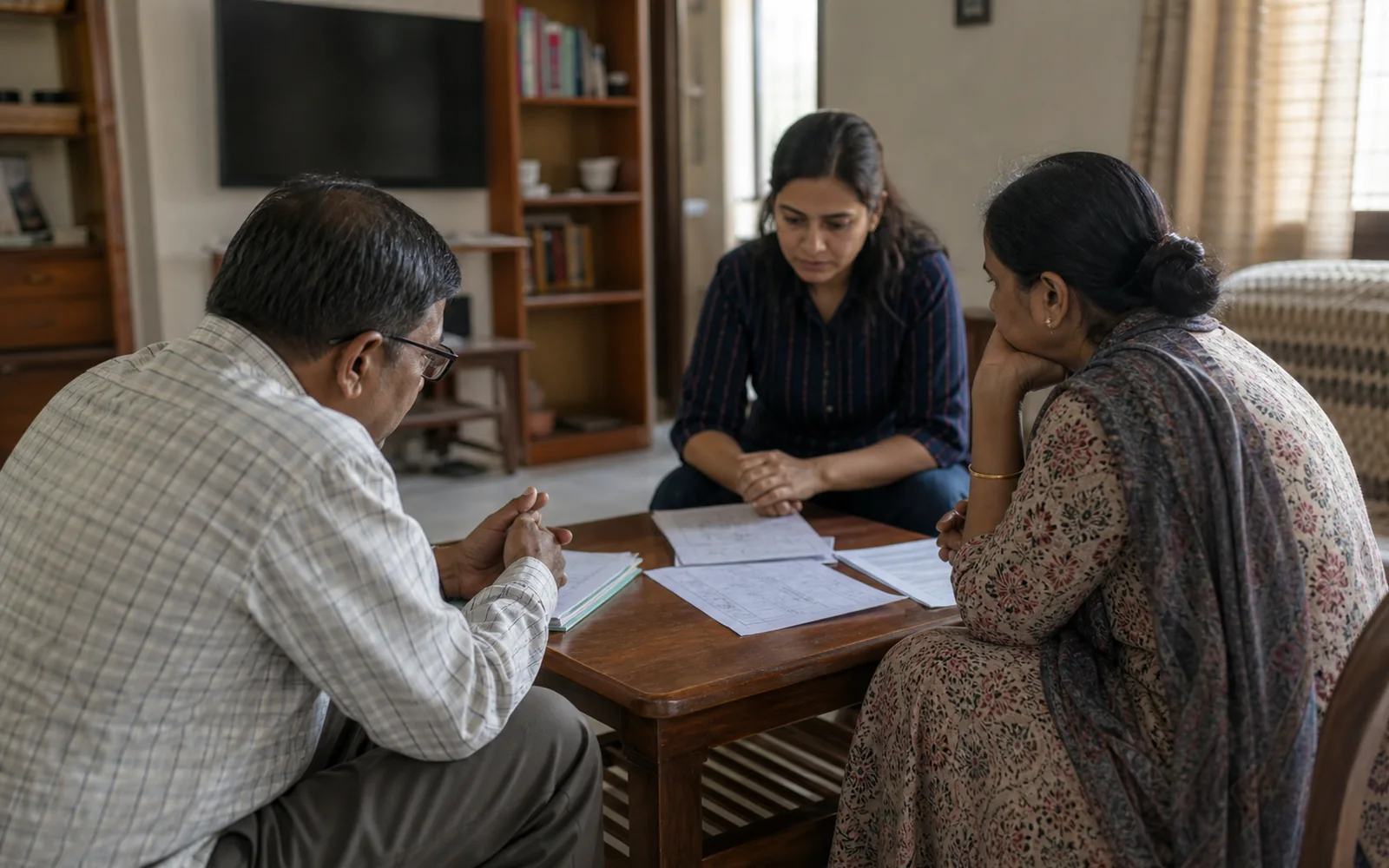
A refusal is one tradition’s reading of two birth records, and the useful first move is not to argue with it but to find out which reading you got. Somebody looked at two charts and said no. In some households that sentence arrived with a number attached, in some with a dosha named, and in a great many with neither — just the conclusion, delivered to a parent and relayed to you.
Everything since has probably been about whether to accept it. This page is about something narrower and more useful, which is what was actually computed.
What were you actually told?
You were told the output of a named method applied to two birth records by a person who chose that method, those tables and that acceptance line.Four choices sit behind the word no, and none of them is usually stated out loud.
The tradition comes first: the Charak-lineage North Indian reading, B. V. Raman’s South Indian one, a particular panchanga’s house of practice, Kerala convention, or the Tamil ten-porutham system, which is not the eight kootas under different labels but a separate instrument with its own weights and its own acceptance point. Then the tables, which differ cell by cell between printed sources on more kootas than most people expect. Then the birth data, entered by hand from something a relative remembered. Then the line, which in the north is conventionally eighteen out of thirty-six and in the south is something else entirely.
The tables are the part nobody thinks to question, and they are not identical between printed sources. The rule sets descend from a small number of texts — the Brihat Parashara Hora Shastra in Santhanam’s translation, the Manasagari Paddhati, the Jataka Parijata, and a twentieth-century handbook literature that reprinted them with quiet edits. Where two of those disagree about a single cell, two careful practitioners hand you two different scores and neither has made an error.
Change any one of those and the answer can change while every step of the arithmetic stays correct. That is not a loophole anybody is exploiting. It is the ordinary structure of a subject that grew in several places at once, and the pieces on the reasons two astrologers give opposite answers works through where the five schools part company.
So the honest description of what happened is not “the charts do not match”. It is “under a particular reading, applied to these particular entries, the result fell on the wrong side of a particular line”. That sentence is longer and it is the one you can do something with.
How common is the finding that refused you?
Almost certainly far more common than the way it was delivered suggested. Most refusals rest on one of three or four named findings, and the striking thing about those findings is how much of the population they cover.
Nadi dosha — scoring zero on the koota worth 8 of the thirty-six points — applies to 33.3% of all pairings, because there are three nadis and nine of the twenty-seven stars sit in each. Bhakoot dosha applies to 50%, which falls straight out of the arithmetic of twelve rashis and the six distances the rule counts against. Neither number is an estimate. There are exactly one hundred and eight nakshatra-pada positions a Moon can occupy, so 11,664 ordered pairings is the whole population, and we ran every one of them.
Mangal dosha is stranger, because the share of charts flagged depends less on the chart than on who is asked. Across the same corpus of charts the flagged rate runs from 11.7% under Astro-Vision (serious Kuja dosha only) to 73% under OP / SKU panchangas. Same planets, different published rule — and the point Mars is judged from, which almost nobody names, turns out to move the rate about ten times further than the house-list argument everybody actually has.
The total score is less dramatic than it sounds too. The mean Ashtakoota total across every possible pairing is 20.1 out of thirty-six, and 66.7% of pairings clear the conventional line. A score in the low teens is genuinely unusual. A dosha is not, and the base rate tables give the figure for every finding rather than the three most quoted ones.
None of this makes the verdict wrong. It shows how common the finding is among possible chart pairings, not how often it occurs among married people.
Would another school have refused you too?
Another school may reach a different conclusion, but that needs to be checked for your charts. The census enumerates possible chart pairings, not real couples, and its combined figure includes veto flags even where schools do not disagree.
Scored under five schools across all 11,664 ordered pairings, 56.4% trigger a tested difference or veto across the combined census checks. On the separately sampled Mars axis the spread is wider still: 61.4% of charts in the manglik census are flagged under one published house set and clean under another.
The published sample case shows the shape of it better than any percentage does. Priya, born in Pune, and Arjun, born in Chennai, score 17 under the North Indian tables and 13.5 under the South Indian ones. Three of the five schools refuse the match and two accept it — and the two that accept are the two with the lower totals, because they score on a different scale with a different line. A family shown only the higher number and the word “refused” has been told something true and has not been told the situation.
There is a version of this that is worth arguing with, and it is the version that says the disagreement makes the whole thing meaningless. It does not follow. Each school is internally consistent and faithful to the source it descends from. What follows is narrower: no single reading of your two charts can honestly be presented to you as the reading, and anybody who does present it that way has made a choice they have not disclosed.
What are your options, honestly listed?
There are five, and only the first three are things anybody can do for you. The other two happen in your own house, and in most families they are what actually resolves the matter.
One: establish which reading you received
The tradition, the tables, the birth data as entered, the line applied. A verdict without its method is not something anyone can examine, agree with or dispute. Most reports do not state the method; most practitioners will state it when asked directly, and the five questions that get a method out of a verdict are written to be asked without accusing anybody of anything.
Two: have the same charts read under the other documented traditions
Not to hunt for a better answer. To find out whether the answer is stable. If four documented schools land where the first one landed, you have learned something real, and it is not the thing you were hoping for. If they split, the argument at home changes from who is right into which tradition your household follows, which is a question a family can actually answer. Our matching tool prints all five side by side with the source each verdict rests on.
Three: ask which cancellation rules were checked
Every tradition carries conditions under which a finding is set aside, and they are specific rather than vague: a shared rashi, mutually friendly lords, a particular placement. Two people applying different registries to the same dosha will hand you different verdicts and both can name a source. The page on which cancellations are actually cited separates the ones that appear across the classical sources from the ones that circulate widely and cannot be located in a printed edition at all.
Four: find out whether the birth times can bear the weight
Some findings sit so far from a boundary that an hour of clock error would not touch them. Others sit a few minutes from an edge, and a birth time rounded to the nearest quarter hour cannot decide them. Which kind you are holding is knowable before any argument is had, and the four-minute test is one computation rather than a debate.
Five: decide, as a family, what weight this carries
Nobody writes this one down, and for a great many households it is the option that ends the matter. Some families conclude that a tradition’s reading is decisive. Some conclude that it is one input among several. Both are positions a family is entitled to hold and neither of them needs a second computation to justify it.
What should you gather before you ask anybody anything?
Four things, none of which commits you to a decision. Assembling them takes an evening and it converts a general grievance into a precise question.
Both birth dates, both birth times exactly as recorded, and both birthplaces — with a note beside each time saying where it came from. A municipal certificate, a hospital admission slip and an aunt’s recollection are three different grades of evidence and they get treated as one the moment they are typed into the same box. If two family members remember two different times, write down both. That disagreement is data, not an embarrassment.
Then the verdict itself, in whatever form it arrived: the printed report, the forwarded message, or your own note of what was said on the phone. Then the name of the tradition or the software, if it appears anywhere on the page. And finally the specific finding — the dosha named, the total scored, or both.
A surprising number of refusals dissolve at this stage without anybody rereading a chart, because a birthplace was entered as the district headquarters rather than the town, or a time was read off a certificate that records the registration rather than the birth. Neither is anybody’s fault. Both are recoverable only if somebody thought to check.
What can a second computation honestly change?
It can tell you how many verdicts exist on your two charts. It cannot change the charts. That distinction is worth holding onto, because the gap between the two is where most disappointment lives.
A second reading establishes four things. Which school produced the verdict you were given. What the other four schools conclude on the same data. Which cancellation rules were tested, which passed, and which failed and by how narrow a condition. And how common each of those findings is across the whole population of pairings rather than in the impression of one practitioner.
What it cannot do is produce a verdict that does not exist. If all five schools refuse and every sourced cancellation fails, the report says exactly that, in the same typeface as everything else. That is a real outcome and there is a case for wanting it: an argument that ends is better than an argument that keeps being reopened by whoever last spoke to a different astrologer.
Nor can it settle a disagreement about which tradition your household should follow. That is the question a split result hands back to you, and it is not an astrological question at all — it is a question about whose practice your family belongs to, which region the two sides come from, and how much weight this household has historically given the matter. No computation answers it and any service claiming to has overreached.
The temptation in this business is obvious and worth naming. A service that quietly surfaces whichever reading the customer was hoping for is not a second opinion, it is the first astrologer with better formatting. The only defence against that is printing the strict readings at the same size as the lenient ones every time, whichever way they fall.
What do you say to the relative who thinks you are shopping for an answer?
That you are not asking for a different verdict, you are asking for all of them at once — and that you will show him the ones that refuse you too. This is the argument you will actually have to win, and it is not won with citations.
His objection is a good one and deserves to be treated as one. If a family keeps asking until somebody says yes, the yes means nothing, and everyone in the room knows it. He has probably watched somebody do exactly that. Answering him with “but this software is more accurate” concedes the point, because accuracy was never what he doubted.
What answers him is the shape of the request. One computation, run once, printing every documented school in a fixed order with the source beside each verdict and the harsh readings included. He can check any cell of it against a printed edition if he wants to. Nothing about it can be reordered to flatter a conclusion, because the order was decided before the charts were entered.
And there is a fact worth putting in front of him that has nothing to do with astrology. Research on how Indian families weigh match criteria — Banerjee, Duflo, Ghatak and Lafortune measured this directly in the marriage-advertisement market — finds horoscope and caste filters treated closer to absolute constraints than to preferences that trade off against anything else. He is not being unreasonable by the standards of the room he grew up in. Telling him he is will lose you the conversation and the marriage.
How do you keep the other family in the conversation?
By sending them the same document you are reading, rather than the conclusion you drew from it. Most matches that end after a refusal end because one side went quiet while it worked out what to think, and the other side read the silence as an answer.
The mechanics of this matter more than the argument does. If your family commissioned the second reading and then presents its conclusion, the other side is being handed a verdict by an interested party, which is precisely the objection you spent the last section answering. If both sides look at the same five columns at the same time, nobody is being told anything — they are reading.
There is a practical asymmetry worth planning around. The refusal usually came through one household’s astrologer, and that person is a relationship as much as a service: somebody’s family has consulted him for twenty years, he named a child, he fixed a muhurta. Asking that family to disregard him is asking a great deal more than it sounds like. Asking them to put his reading next to four others, with his own tradition named and his own verdict printed first, costs them nothing and takes nothing away from him.
It also helps to be specific about what you are and are not proposing. You are not proposing that the finding is false. You are proposing that the household find out whether the finding is one school’s or all five schools’, and that both families see the answer together. That is a small enough request that refusing it looks stranger than granting it.
And if the other family declines, take that seriously rather than as an insult. Some households have decided in advance that the tradition is decisive, which is a position they are entitled to hold and one you would want to know about before a wedding rather than after. A refusal to look is itself an answer to a question worth having asked.
Where do remedies fit, and who should you be wary of?
Traditions prescribe observances, we can tell you which text prescribes what, and nobody can tell you what one does. The distinction between a cancellation and a remedy is the one that gets blurred most often, usually by somebody with an interest in blurring it.
A cancellation is a clause inside the rule set. The same authority that declared the finding also declared the circumstances in which it does not apply, and whether your two charts meet those circumstances is a question with a checkable answer. A remedy is an action taken afterwards — a fast, a recitation, a stone, in some sources a sequence performed before the wedding. Its effect is not something we can establish and we do not claim otherwise.
The pattern to be careful with is a fee quoted in the same breath as the verdict. A person who finds the problem and sells the cure has a conflict that no amount of sincerity resolves, and the cleanest way not to have it is not to be in that business. We take no commission on any observance and refer nobody.
Which is not an argument for hiding what the sources say. A report that suppresses the observance its own text prescribes is not being transparent either. Print it, name the text, mark it as what that tradition prescribes, and stop there.
What does none of this tell you?
How a marriage will go. That is not modesty and it is not legal throat-clearing. It is the limit of what the method contains.
Matching describes what a named tradition concludes about two sets of birth data and how common that conclusion is. Everything on this site is of that kind, and the reason is that claims of that kind can be checked by somebody who does not trust us. Anyone who converts a koota table into a statement about two lives has stepped outside the tradition and is speaking on their own authority, whatever they are wearing while they do it.
The astronomy, incidentally, is not the soft part of any of this. Positions are computed against the published JPL planetary and lunar ephemerides and checked against them, and the disagreement is a fraction of an arcsecond on a pada fifty arcminutes wide. All of the uncertainty that matters lives in the rule choices and in the birth record. That is also why more decimal places will never settle a dispute made of two different verses.
So the next step is small and it is not a decision. Write the four items down, then ask the five questions. Whatever comes back, you will be holding a labelled reading instead of a bare conclusion, and a labelled reading is something a family can discuss.
Questions people ask
We scored 15 out of 36. How bad is that?
It is below the conventional line of 18 and above the bottom of the range. The average total across every pairing that can exist is a little over 20, so a total in the mid-teens is on the low side of ordinary rather than rare. What matters more is which kootas the loss came from, because a total of 15 built from nadi is a different reading from a total of 15 built from four small deductions.
Is it wrong to ask a second astrologer?
Not on its own. It becomes a problem when you stop at the first answer you liked, which is the thing relatives are right to be suspicious of. The version that survives scrutiny is asking for every documented reading at once, including the ones that refuse you, and putting all of them in front of the family together.
The astrologer will not explain the reasoning. What now?
Ask once more and ask smaller: just the house list, just the birth times entered, just the koota scores one by one. Plenty of careful practitioners work from tables they have used for decades and have never been asked to name them. Silence is information but it is not proof of anything.
Sources
Claim-level links appear in the article; URL-derived IDs keep each full reference identifiable if this list is reordered.
- DR-1F1F7DE Brihat Parashara Hora Shastra, Santhanam translation — Internet Archive scan, 1984 translation
- DR-FV7H4 Manasagari Paddhati, Vanshidhar edition with Hindi tika — Internet Archive scan, 1939 printing
- DR-1NR5UTO B. V. Raman, A Manual of Hindu Astrology — Internet Archive scan, 1935 edition
- DR-D2SRWR National Family Health Survey (NFHS-5), India report — International Institute for Population Sciences, 2021
- DR-1F6U0ET Marry for What? Caste and Mate Selection in Modern India — American Economic Journal: Microeconomics, 2013
- DR-EQ8C4Q Census of India — household and marital status tables — Office of the Registrar General, Government of India, 2011
- DR-30WG0O Planetary and Lunar Ephemerides DE440 and DE441 — NASA Jet Propulsion Laboratory, 2021
Use the evidence
Check it on your own chart
These tools apply the same named rules described above. They are free, require no sign-up, and store nothing.