If your match was refused · Evidence-led explainer
Is your birth time even right? A four-minute test
See how birth-time accuracy affects Lagna, houses and matching verdicts, why a few minutes matter for some charts, and how to test your own time range.
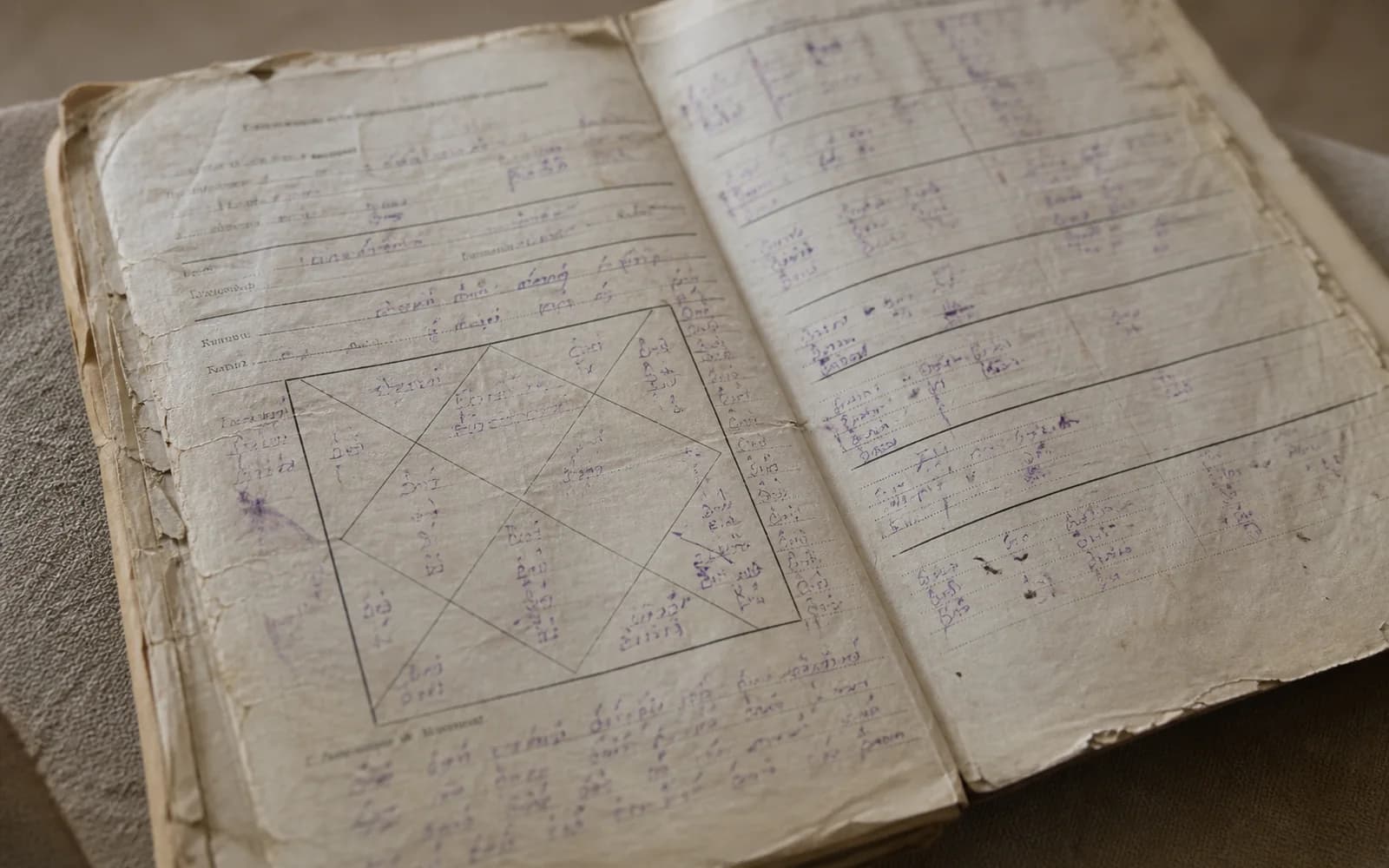
For some charts a four-minute error changes a finding; for most, an hour changes nothing at all — and which one you are holding is knowable before anybody argues about the verdict. Somebody in the family remembers it was around half past seven, or possibly eight. The certificate, if there is one, says 7:30, because 7:30 is what people write.
That is how most Indian birth times were recorded, and it raises a question worth settling early: does the imprecision actually matter for these two charts? It takes one computation to find out, and the answer is usually reassuring.
Which parts of a chart does the clock actually move?
The fast ones, which is not everything. A chart has parts that change within minutes and parts that change within days, and matching draws on both.
The fast part is the ascendant — the lagna, the sign rising in the east at the moment of birth. The whole zodiac rises over roughly a day, so the rising point advances about one degree every four minutes. The exact rate varies with latitude and with which sign happens to be rising, and near the equator it is steadier than it is in the north, but the order of magnitude holds everywhere. A sign is thirty degrees wide. A birth two hours from a sign boundary is untouchable by any plausible clock error; a birth eight minutes from one is not.
The slow part is the Moon. It crosses the whole zodiac in about twenty-seven days, which works out to a nakshatra pada boundary roughly every ninety minutes and a whole nakshatra every day. That is slow enough that most quarter-hour errors leave the birth star exactly where it was — and since all eight kootas are computed from the Moon’s nakshatra and rashi, most of the thirty-six points are untouched along with it.
So the summary is lopsided rather than reassuring in general. A rough birth time threatens anything judged from the ascendant, which includes Mangal dosha under any tradition counting houses from the lagna. It rarely threatens the guna score. Unless the Moon happens to be sitting near an edge, in which case it threatens the whole thing at once, because a moved birth star recomputes every koota from a different starting point.
What does four minutes change, exactly?
One degree of ascendant, a few arcminutes of Moon, and nothing else worth naming. Putting actual quantities next to each other is what turns a vague worry into a decidable question.
Four minutes of clock error moves the rising point by roughly a degree. Over the same four minutes the Moon travels about two arcminutes, which is a twenty-fifth of a pada. The Sun moves a tenth of that. Mars, on a day when it is not stationary, moves less still.
Now consider what each of those can flip. A degree of ascendant flips a sign only if the birth was already within a degree of the boundary, which is about a thirtieth of all births by rising sign — not rare, not common. Two arcminutes of Moon flips a pada only for a birth already within two arcminutes of a pada edge, which is a fifteen-hundredth of the pada’s width. The asymmetry between those two probabilities is the whole reason this test is worth running: most of the time the question is entirely about the ascendant.
There is a third quantity worth having in mind. Fifteen minutes — the rounding people actually apply when they write a birth time down — moves the ascendant by about four degrees, which is an eighth of a sign. That is the realistic error to test against, and it is why the test below uses fifteen minutes rather than four as its middle rung. The ascendant calculator will show you where in its sign a given time falls, which answers the question for that half of the chart in one look.
How do you run the test?
Compare the recorded time with several offsets and record the same fields at each one. The whole procedure fits in a paragraph and needs no interpretation to carry out.
Run the match at the recorded time. Then at four minutes either side, then at fifteen minutes either side, then at an hour either side. At each run, record the ascendant sign for both people, both birth stars, and the verdict on every named finding — the total, the doshas, and whether each school accepts.
Run it on both charts independently. This is the step people skip, and it costs them the most useful half of the answer. Sensitivity is a property of a chart, not of a couple: one person can be born in the middle of a sign with the Moon in the middle of a pada, and the other four minutes from two boundaries at once. Testing the pair as a unit tells you that something is fragile without telling you whose birth record needs the attention.
Our birth time sensitivity toolchecks one chart at a time at offsets of one, two, five, ten and fifteen minutes, or at half-hour samples across the day when time is unknown. It is not the broader manual sweep described above and does not locate every transition. To compare full match outputs at other offsets, use the matching calculator and keep a written record.
How do you read the three possible results?
Stable, hinged at the margin, or hinged inside the rounding — and two of the three end the conversation. Every outcome falls into one of them.
- Stable. Nothing changes across the whole hour. The birth time is not your problem, however loosely it was recorded, and you can put the question down entirely. This is the most common result and it is worth having in writing, because “we are not sure of his birth time” will otherwise be raised again by somebody every few weeks.
- Hinged at the margin. Nothing moves at four minutes, but something moves at fifteen or at sixty. The recorded time is probably good enough, and you now know exactly which finding is the fragile one and how much error it would take to move it. That is a fact to state in the report rather than a reason to distrust it.
- Hinged inside the rounding. A finding flips within four minutes, which is well inside the width of a birth time written as a round number. Here the honest position is that the chart does not support a confident verdict on that finding, and saying so is more accurate than picking a side and defending it.
The useful output of this test is not a better birth time. It is knowing whether the birth time was ever load-bearing.
What did the test say about the published sample couple?
One ascendant changes sign within minutes, and not one of the five verdicts moves. The sample case is the middle result, which makes it more instructive than either extreme would be.
Priya, born in Pune, and Arjun, born in Chennai, are the couple the published sample report is built on. Run the sensitivity test on them and the two charts come back differently: hers is sensitive and his is stable. Her ascendant crosses from Tula into Vrishchika with a shift of only 3 minutes. His does not move at all.
A reader could stop there and conclude that her birth time is the weak point of the whole reading. It is not, and this is the part worth sitting with: across the entire 30-minute window either side of the recorded times, not one of the five schools changes its verdict. The ascendant that moves is not carrying any of the findings that decided this match. The kootas are computed from birth stars that stay put, and the manglik readings on these two charts do not sit near a boundary that the shift crosses.
That is the shape a great many charts have. Something visibly moves; nothing that matters moves with it. A report that flagged the ascendant shift as a warning without saying that no verdict follows from it would be technically accurate and practically misleading, which is a description of most of the anxiety in this subject.
Is the uncertainty in the clock or in the sky?
In the clock, by several orders of magnitude, and it is not close.The instinct is that the astronomy is the soft part of a chart. It is the hardest part in it.
Planetary positions are computed from a modern ephemeris and checked against NASA JPL’s published planetary and lunar ephemerides. Measured across every body matching uses, at 2,000 instants sampled between 1900 and 2100, the worst disagreement is 0.44 arcseconds against a tolerance of 2. The Moon’s own worst figure is 0.37.
Set that beside the thing it has to decide. A nakshatra pada is fifty arcminutes wide — three thousand arcseconds. The Moon covers the entire measured error in under a second of its own motion. Anyone can check a single position independently in JPL Horizons and see the same thing.
A birth time rounded to the nearest quarter hour moves the ascendant several degrees. The gap between those two magnitudes is not a matter of opinion. Whatever doubt a chart carries came in through the birth record or through the rule choices, and the ayanamsa is the other input worth checking — the common values differ by more than a degree, which is enough to move a Moon near an edge into the next star.
Which is also why a report ought to say when a finding sits near a boundary. A verdict quoted to a decimal place, computed from a birth time somebody half-remembers, is claiming a precision the input never had.
Why are Indian birth times recorded so loosely in the first place?
Because for most of the last century nothing in the recording chain needed the minute, and several parts of it could not have supplied one. This is worth knowing mainly so that nobody feels their family was careless.
India runs on a single national offset across a country spanning nearly thirty degrees of longitude, which means local solar noon in the north-east and in Gujarat differ by the better part of two hours. That is not an error — sidereal computation handles it correctly from the longitude — but it means the wall clock and the sky have never obviously agreed anywhere, so a clock reading has never felt like a measurement of anything astronomical.
The offset itself is younger than many of the birth records that matter here. Bombay and Calcutta kept their own local times well into the twentieth century, and the time zone database records when each transition happened. A chart cast for 1948 in one of those cities has a question behind it that a chart cast for 1990 does not.
Then the ordinary friction. A ward clock nobody had checked against the national time standard in years. A note written when the paperwork was done rather than when the child arrived. A registration date entered where a birth time was asked for. A grandmother’s recollection anchored to the azaan or to when the milk came, which is often more reliable than the certificate and is never recorded as such.
None of that makes a chart worthless. It makes the provenance of the time worth writing down beside it, which almost nobody does, and which costs one line.
What if the birth time is genuinely unknown?
Two routes are honest and one popular one is not. Having no recorded time is more common than people admit in front of a matchmaker.
The first honest route is to compute what can be computed without it. The Moon usually stays in one nakshatra for most or all of a day, so on many dates the birth star follows from the date alone — and with the birth star come the guna score, nadi, bhakoot, gana and the rest of the eight. Where the Moon does cross a boundary during the day, there are two possible readings, and both can be stated. Two labelled possibilities are a far better position than one confident answer resting on a guess.
The second is rectification: the classical practice of working backwards from dated life events to a time consistent with them. Traditions differ on how much confidence it earns and it is slow work done by a person. What matters is that it arrives labelled as an inference with reasoning attached, not as a fact that was recovered.
The route to be careful with is the silent noon default. Software that substitutes 12:00 for a missing time produces an ascendant, and that ascendant sits on the page looking exactly as authoritative as a real one. Every house-based finding in the report is then decided by a placeholder, and nothing on the page says so. If a Mangal verdict came from a report where the birth time was blank, that verdict is about the software’s default rather than about anybody’s birth.
What does the test not tell you?
It does not recover your birth time and it does not tell you which candidate time is correct. It measures how much the answer depends on the input, which is a different question and a smaller one.
A stable result does not mean the recorded time is right. It means the checked fields stayed unchanged at the sampled times. It says nothing about an hour-wide uncertainty if only fifteen minutes were tested, and it cannot rule out changes between samples. A changing result identifies a sensitive field, not the true birth time. Other findings need their own dependency checks.
It also says nothing about whether the rule that produced the finding is the rule your household follows. That is the larger source of disagreement by some distance, and it does not move when the clock does. Two schools reading the same chart at the same instant still land in different places, which is the subject the page on what to do after a refusal takes up.
How should this change the argument about a refusal?
It removes one variable from a conversation that currently has too many, whichever way it comes out. That is worth more than it sounds, because arguments with several loose variables in them never end — they just rotate.
If the finding against you is judged from the ascendant, as most Mangal dosha readings are, then the birth time belongs in the discussion alongside the house list and the reference point. Those two rule choices already move the share of charts flagged manglik from 11.7% to 73% across the same charts, and the reference point is the larger of the two by a wide margin. A soft birth time sits on top of that rather than instead of it.
If the finding is nadi or bhakoot, the birth time is very probably beside the point and the conversation should move on. Nadi dosha applies to 33.3% of every pairing that can exist — a figure computed over the whole population of nakshatra-pada pairings rather than estimated — and it is decided by the birth star, which a quarter of an hour will not usually touch.
So run the test first, before anybody rereads a chart or rings a second astrologer. You will find out whether “but we are not sure of his birth time” is a real objection in your case or simply a true statement with no consequences attached to it. Both answers are useful. One of them you can stop repeating.
Questions people ask
My birth certificate time and my family’s memory disagree. Which do I use?
Record both and run the test on both. If every finding is identical across the two, the disagreement does not matter and you can stop worrying about it. If a finding differs, you have located the exact place where the record is doing the deciding, which is worth knowing before anybody argues about the verdict.
Is birth-time rectification reliable?
It is a classical practice with a method: working backwards from dated life events to a time that fits them. Traditions differ on how much confidence it earns, and it is slow work done by a person rather than a calculator. What matters is that the result is presented as an inference with reasoning attached rather than as a recovered fact.
Does the software just use noon when the time is missing?
Some do, and the result looks exactly as authoritative on the page as a real one. An ascendant generated from a placeholder produces house positions, and anything judged from those houses has then been decided by the default rather than by the birth. Ask what was entered before you take a house-based finding seriously.
Does the ayanamsa matter more or less than the birth time?
They act on different parts of the chart. The ayanamsa shifts every sidereal position by the same amount, so it matters when a Moon or a planet sits within about a degree of a boundary. The birth time moves the ascendant fast and the Moon slowly. A chart can be untroubled by one and decided by the other.
Sources
Claim-level links appear in the article; URL-derived IDs keep each full reference identifiable if this list is reordered.
- DR-30WG0O Planetary and Lunar Ephemerides DE440 and DE441 — NASA Jet Propulsion Laboratory, Solar System Dynamics, 2021
- DR-1E3NI3P The JPL Planetary and Lunar Ephemerides DE440 and DE441 (Park et al.) — The Astronomical Journal, 2021
- DR-AXILXB JPL Horizons System — independent position lookups — NASA Jet Propulsion Laboratory, 2025
- DR-9AH1WP Time Zone Database — historical offsets for Indian localities — Internet Assigned Numbers Authority, 2025
- DR-12AUHUO Time Zone in India — the single national offset — Time and Date AS, 2025
- DR-PE74GF India’s national time standard and its dissemination — CSIR-National Physical Laboratory, New Delhi, 2025
- DR-DDY8TY Rashtriya Panchang and the Indian Astronomical Ephemeris — Positional Astronomy Centre, India Meteorological Department, 2025
Use the evidence
Check it on your own chart
These tools apply the same named rules described above. They are free, require no sign-up, and store nothing.