Real-life decisions · Evidence-led explainer
How should Kundli matching be used in a love marriage?
Use Kundli matching without erasing years of relationship evidence: verify a refusal, speak with parents and protect consent and safety.
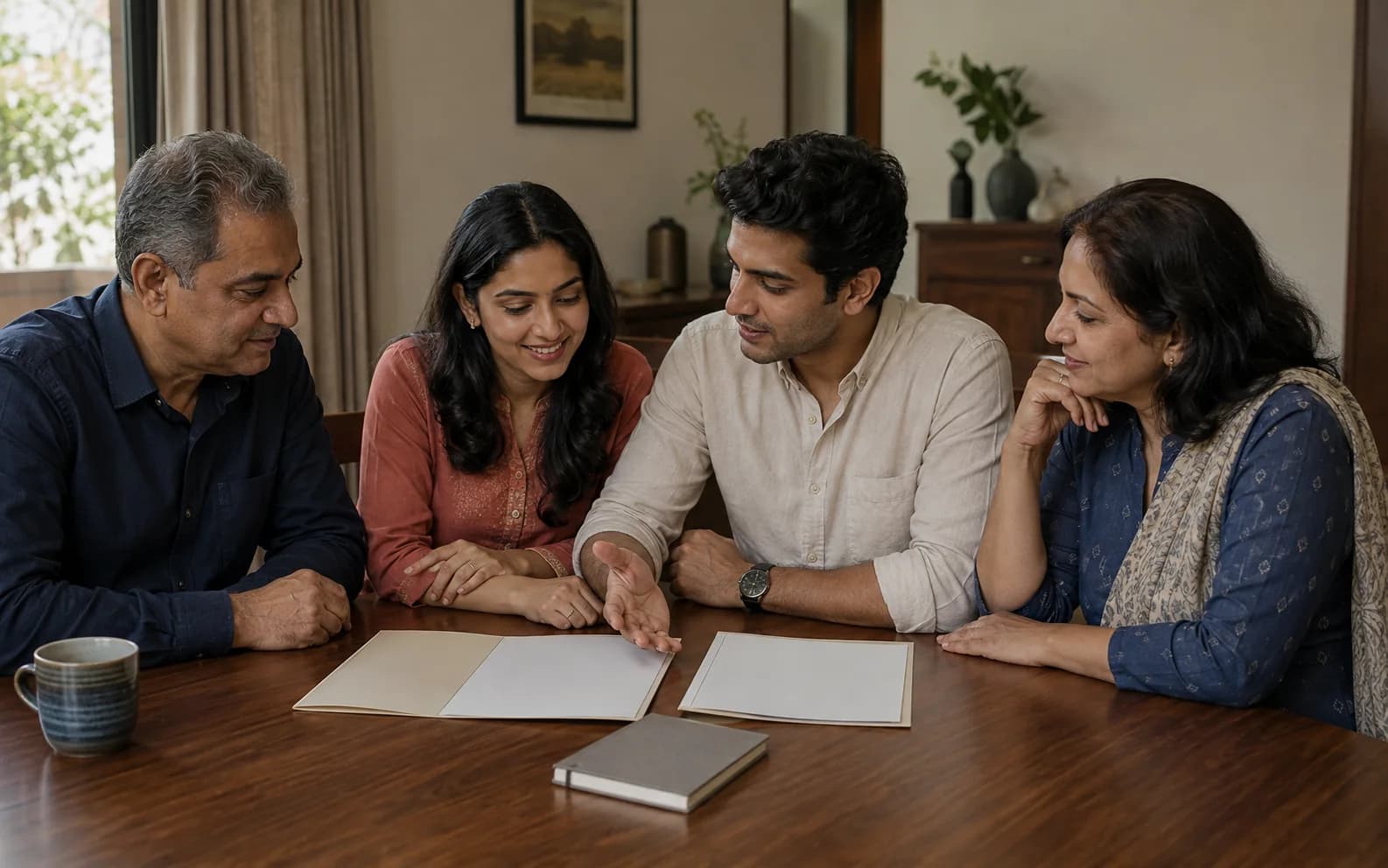
Kundli matching can be used in a love marriage, but it enters a decision that already contains years of direct evidence. The astronomical calculation need not change; its role must. A couple who have handled distance, money, illness, conflict, careers and family boundaries know things about their relationship that no birth chart receives as inputs.
The difficult version arrives late. Two adults have built a serious relationship, families become involved, and a matching verdict appears as a new pass/fail gate. The couple hears a statement about their charts; the parents hear a warning about responsibility; everyone begins arguing about whether astrology is true. The actionable question is smaller: what exactly was calculated, and what authority did everyone agree that result would have?
This guide respects the family’s practice without allowing a score to impersonate consent, medical evidence or observed behaviour. If your first problem is a specific refusal, use the refusal checklist beside this conversation plan.
Does matching work differently for a love marriage?
The same koota and Dosha rules can be applied, but the decision context is not the same as an introduction between strangers. In an arranged-marriage screen, astrology may be used before the two people have meaningful evidence about each other. In a long relationship, the couple has a record.
A Guna score compares traditional categories derived largely from the Moon’s nakshatra and rashi. Manglik checks Mars against selected houses and origins. Regional systems add their own criteria, and a responsible report cites the text behind the table. None asks how the couple repaired their last disagreement, whether both want children, who will care for aging parents or whether either person controls the other’s money.
That does not make the traditional calculation meaningless to someone who values it. It sets its scope. A result can become a prompt: “The chosen method marks Graha Maitri low; how do we actually experience conversation and decision-making?” What it cannot do is overwrite the observed answer.
Research on changing Indian marriage forms, including Fuller and Narasimhan’s work on companionate marriage, shows that family participation and couple choice are not simple opposites. Many marriages combine both. A useful matching process should be able to do the same: honor a family lens while leaving the decision with the adults living it.
When should the couple decide what role astrology will play?
Before anyone calculates the charts. Once a frightening result arrives, negotiating the rules of the process looks like negotiating only because the answer was unwelcome.
Choose one of four roles explicitly:
- Veto: either family will not proceed if its chosen method rejects the pair.
- Caution: the result triggers a deeper review but does not decide alone.
- Ritual requirement: the family wants the tradition observed and may accept documented exceptions or practices.
- Conversation input: the result is used to frame questions, not grant permission.
None is automatically the correct role for every family. The harm comes from pretending the role is “information only” until a negative result appears, then turning it into a veto. The couple should also agree on a stopping rule: which system, how many opinions and what happens when accepted methods disagree.
If one partner does not believe in astrology, consent still matters. They may agree to a transparent calculation for family communication without accepting predictions about themselves. They should not be pressured into remedies, public chart sharing or endless consultations as the price of family approval.
What should happen after a low score or Dosha?
Convert the verdict into a trace before debating the relationship. Ask for the printed birth inputs, koota breakdown, named Manglik method, regional system and every cancellation tested.
A bare “14/36, do not marry” combines eight rows and discards their composition. A bare “Nadi Dosha” omits whether the report checked the exceptions recognized by its own school. A bare “Manglik mismatch” omits which houses and reference points created each label. The five-tradition Kundli Milan tool can show whether the objection is shared or method-specific.
Check birth-time evidence next. A remembered round hour can change Lagna-based houses; a Moon boundary can change nakshatra or pada. Do not change the time until the result improves. Test the honest uncertainty range and report what stays stable.
Then separate agreement from disagreement. If all accepted methods find the same condition, say so. If one family’s method finds it and another does not, the decision is partly about which tradition the marriage will recognize. That is a real family question, not a calculation error.
How do you talk to parents without insulting their belief?
Begin with the exact concern they are trying to protect against, acknowledge the rule actually found, and ask for a checkable standard. “You are wrong” forces the conversation into identity. “Can we see which Nadi exception your Pandit uses?” keeps it on method.
A useful sequence is:
- “We understand that this result feels important and that you are trying to protect us.”
- “Please help us get the input sheet and exact failed rule in writing.”
- “Let us check whether the same tradition has a cancellation and whether our recorded times are reliable.”
- “If accepted systems differ, can we agree how to weigh that difference?”
- “Separately, here is what we have learned about our finances, values, conflict and family plans.”
The last line prevents astrology from becoming the only language in the room. A family worried about future hardship may be reassured more by a real savings plan, shared caregiving expectations or evidence of respectful conflict than by another unexplained number.
Do not collect secret favorable opinions and reveal only the winner. That looks like manipulation because it is selection by outcome. A proper second opinion preserves the original method and explains why another accepted method differs.
What if caste, religion or region is part of the objection?
Separate identity, family custom and astronomical calculation; they are not the same input. The Moon does not change nakshatra because the couple is inter-caste. Mars does not move house because one partner is from another religion. What can change is whether a family regards a particular matching system as applicable.
Banerjee and colleagues’ study of caste and mate selection documents how social preferences shape the marriage market. That evidence helps explain the power of family filters. It does not establish an astrological rule against a particular identity.
The national context in the NFHS-5 India report is useful for understanding marriage and household decisions at population scale; it is not evidence that any one couple should accept a family veto.
Inter-regional marriages create a genuine method question. A North Indian family may use Ashtakoota while a Tamil family expects 10 Porutham and Rajju; a Kerala reader may foreground Papasamyam. The inter-regional matching guide shows how to compare them without calling either a translation of the other.
If astrology appears only after a family learns caste or religion, ask whether the chart is the reason or the socially acceptable language for another objection. The answer may be uncomfortable, but no calculation can resolve a disagreement that is actually about belonging.
What real-world evidence should sit beside the chart?
Evidence about consent, safety, respect, conflict, money, health disclosure, children, work and family boundaries. A long relationship creates opportunities to observe these; it does not automatically guarantee that every area is healthy.
The NHS guidance on maintaining healthy relationships emphasizes respect, support, open conversation and boundaries. Those are behaviours a couple can discuss and observe directly; a matching table does not receive them as inputs.
Discuss concrete behaviour rather than compatibility adjectives:
- Can either person say no without punishment or withdrawal?
- How are apologies, repair and recurring conflict handled?
- Are income, debt, spending and obligations disclosed?
- Do both want children, and what if fertility or plans change?
- Whose career determines city, travel or relocation?
- What financial and caregiving commitments exist toward parents?
- How are privacy, friendships, clothing, work and digital access treated?
The practical compatibility guide turns those headings into a structured conversation. Its purpose is not to “beat” astrology. It covers fields the chart does not receive.
A favorable report must never neutralize warning signs. The World Health Organization’s overview of intimate-partner violence describes real patterns of harm; no Guna score certifies their absence. If someone feels unsafe or controlled, seek appropriate personal, professional or emergency support rather than another matching calculation.
Can a remedy be a respectful compromise?
It can be a voluntary religious or family practice, but it should not be sold as proof that a predicted catastrophe has been prevented. The couple should understand whether the proposal is a calculation cancellation, an observance or a paid service.
A cancellation belongs inside the rule set: a documented condition changes how the tradition classifies a Dosha. A ritual remedy does not move the natal planet. It may hold meaning, mark family acceptance or give participants comfort. Those are legitimate human functions when participation is free and the claims are honest.
Red flags include threats that refusal will kill a spouse, claims that only one expensive practitioner can fix the chart, secrecy, urgent payment, black-magic accusations and practices intended to override another person’s will. Vashikaran is not a substitute for consent.
If the family proposes a remedy, ask: Is it optional? What is the cost? Who benefits financially? What exactly is promised? Can the couple choose a simpler devotional practice? Will everyone accept that no outcome is guaranteed? A compromise reached through fear is not a compromise.
What if the parents say every future problem will be your fault?
That warning creates an impossible burden and should be addressed before marriage, not accepted as the price of approval. Every marriage encounters difficulty. A prior Dosha can become a permanent explanation for unrelated events and a tool for blaming the partner whose chart carried the label.
Ask the family to distinguish responsibility from prediction. The couple can take responsibility for choices, communication and care. They cannot accept responsibility for proving a cosmic warning wrong every day for the rest of their lives.
Write a boundary together: “We have heard the traditional concern and made our decision. Future health, money or relationship problems will be addressed using relevant evidence and will not be attributed automatically to one person’s chart.” This may feel formal, but the accusation it prevents is serious.
If threats, confinement, forced marriage, harassment or violence enter the situation, the issue is no longer a content question. Seek trusted local support and appropriate legal or safety help. An astrology report should never be used to justify coercion.
When can a second opinion help—and when can it not?
It helps when the disagreement is computational or doctrinal; it cannot decide whose values govern the family. A corrected time zone, alternate koota table, different Manglik house set or documented cancellation can explain why two readers split. That is useful evidence.
It cannot make a parent accept an interfaith marriage, make a partner want children, resolve disrespect or grant consent. If the family says it will accept any recognized method and then rejects every favorable explanation, the remaining obstacle may not be the chart.
A good second opinion states points of agreement as prominently as points of difference. It does not promise to save the relationship. Read the sample first and ask whether the document’s method trace answers the actual objection.
The goal is not to defeat a family in debate. It is to make the role of astrology visible, keep factual claims within their evidence, and return the life decision to the people who must live it.
How can the couple prepare for the family meeting?
Prepare two documents and one shared boundary before the meeting: an astrology trace, a relationship evidence page and a statement of who decides. Mixing all three into one debate makes every factual correction sound like a rejection of the family.
The astrology trace
Keep this page narrow. Print both birth inputs and their sources, the selected regional system, the component score, Manglik method, material Doshas, tested cancellations and any uncertainty. If two accepted methods differ, show them in parallel. Do not include a long defence of the relationship here; this page exists so the technical claim can be checked on its own terms.
Highlight agreement first. “Both reports identify the same nakshatras and the same zero-Nadi row” creates common ground. Then state the first difference: “The second source recognizes this exception; the first source does not.” That is easier to discuss than duelling conclusions marked suitable and unsuitable.
The relationship evidence page
This is not a romance résumé. Record how the couple has handled specific realities: a major disagreement, financial disclosure, distance or relocation, family pressure, illness, career plans and the question of children. Note unresolved items as well as strengths. The page should demonstrate that lived evidence is being examined, not used as a slogan that love conquers everything.
Each partner should write privately first. If one describes the same episode as respectful repair and the other as fear or silent compliance, that difference deserves attention before the family presentation. A high level of family opposition can cause a couple to unite against the outside world while postponing their own difficult conversations.
The decision boundary
Write one sentence that states the family’s advisory role and the adults’ final role. The exact wording will differ across families, but it should answer: Can a calculation veto the marriage? Is a documented alternate tradition acceptable? Is a voluntary ritual enough for family participation? By what date will the process end?
The couple must genuinely agree. If one partner privately believes parents retain a veto while the other believes the meeting is informational, the conflict will reappear after every new objection. That disagreement is not solved by a better score.
How should difficult family objections be answered?
Answer the narrow claim, name the evidence and avoid promising an outcome nobody can guarantee. The goal is a truthful conversation, not a courtroom victory.
If someone says, “The score is below 18, so the marriage will fail,” show the eight rows and the selected threshold, then explain that the total is a rule-based comparison rather than an observed probability of divorce. Ask which component creates the family’s actual concern. A lower total produced by one table may also need comparison with the family’s own accepted table.
If someone says, “Nadi means you cannot have children,” confirm whether the row is actually zero, test the named exceptions, and state that the category does not diagnose fertility or genetics. A medical concern raised by family history should be taken to the relevant health professional, regardless of whether the astrological exception applies.
If someone says, “One partner is Manglik and will harm the other,” replace the identity label with the calculation trace. Name the Mars house, origin and method for both people. Explain any balancing rule without claiming that a ritual guarantees survival. Refuse language that makes one person morally contaminated by a chart position.
If someone says, “Our community never accepts this match,” ask whether the obstacle is a doctrine, a regional custom, caste, religion, language or fear of relatives. Each deserves an honest name. An alternate astrology report cannot solve an identity objection disguised as arithmetic, but naming it can stop the couple from purchasing endless recalculations.
If someone says, “Agree now and we will support you later,” turn support into observable commitments. Will the couple be welcome at family events? Will abusive comments be challenged? Is housing or financial support conditional? Will future illness or conflict be blamed on the chart? Ambiguous approval can become control after marriage.
What happens after the family gives an answer?
Approval is not the end of preparation, and refusal is not permission to skip safety planning. After approval, preserve the agreed interpretation so a relative cannot revive a rejected rule during the first difficult year. Complete the practical discussions about money, location, caregiving, children and privacy. Decide how much chart information may be shared outside the immediate family.
After a conditional approval, record the condition, cost, deadline and whether both partners consent. A reasonable religious observance is different from surveillance, coerced payment or a promise that one spouse must accept lifelong blame. Ask what happens if a new astrologer later disagrees.
After refusal, allow time before taking irreversible steps. The couple may need emotional, legal, financial or housing advice depending on their circumstances. Keep communication safe and do not publish private birth data or family accusations in search of online validation. A public poll cannot carry the consequences for either person.
Whatever the answer, evaluate how each partner behaved under pressure. Did they protect each other’s dignity, tell the truth about their limits and make decisions jointly? Family conflict is painful, but it also reveals the operating patterns that will shape the marriage. That evidence belongs beside the report.
What does a workable decision process look like?
Decide who may attend each stage. A technical reconciliation may need the two adults, the reader and one trusted representative from each family; a private relationship discussion does not need an audience of relatives. More participants can add social legitimacy, but they can also make it harder for either partner to state a boundary safely.
Choose one person to keep the written question list and interrupt topic drift. If the meeting begins with Nadi and moves to caste, salary and a cousin’s prediction, record the new objections under their real headings. Do not let agreement on the original calculation create the illusion that every later condition was also accepted.
Use one shared folder containing the source birth records, original report, second calculation if needed, one-page points of agreement/disagreement, practical compatibility notes and the couple’s decision boundary. This turns repeated oral verdicts into a process everyone can inspect.
Limit the process in advance: one input audit, one named comparison, one family discussion and a date for decision. Endless rechecking rewards anxiety and makes every new rule a reason to postpone.
Give each participant the same document. A verbal chain—astrologer to parent, parent to relative, relative to couple—compresses a conditional result into a warning. The written page should state: what every method agreed on, what changed by method, what could not be checked, and what decision remains with the couple. Nobody has to endorse the alternative tradition to see that it exists.
After the discussion, ask each partner privately whether the process itself changed their view. One may be comfortable with a ritual accommodation; the other may feel that a family veto will continue after marriage. That difference is part of the real relationship decision. Resolve it before treating parental approval as the finish line.
The chart may remain meaningful. The relationship remains real. A mature decision can hold both without pretending either contains the other.
Questions people ask
Is Kundli matching necessary for a love marriage?
It is not a universal requirement. Couples who value the tradition may use it as one input, but they should agree on its role before calculation. A chart cannot replace the evidence already available from the relationship.
What if our Kundlis do not match but we have been together for years?
Identify the exact rule and method behind the mismatch, correct any input uncertainty, and weigh that bounded finding beside observed compatibility. Do not let a bare total erase direct evidence or let direct evidence pretend the family’s belief does not matter.
How can we talk to parents after an astrology rejection?
Begin with shared ground, request the written rule, compare the same inputs under named methods, and separate astrological, medical and practical fears. A family-shareable one-page comparison is usually more productive than collecting secret favorable verdicts.
Does inter-caste or interfaith marriage change Guna Milan?
The Moon positions and koota table do not change because of caste or religion. Custom may affect whether a family considers the system applicable and which regional method it recognizes; that is a social and religious decision, not a new astronomical input.
Can a second opinion convince parents?
It can clarify an input error or genuine method disagreement. It cannot guarantee persuasion, and it should not be presented as a new authority chosen only because it says yes.
Sources
Claim-level links appear in the article; URL-derived IDs keep each full reference identifiable if this list is reordered.
- DR-1F6U0ET Marry for What? Caste and Mate Selection in Modern India — Banerjee, Duflo, Ghatak and Lafortune, American Economic Journal: Microeconomics, 2013
- DR-6V4G1Z Companionate marriage in India: the changing marriage system — Fuller and Narasimhan, Journal of the Royal Anthropological Institute, 2008
- DR-D2SRWR National Family Health Survey (NFHS-5), India Report — International Institute for Population Sciences and Ministry of Health and Family Welfare, 2022
- DR-1AAO7WB B. V. Raman, Muhurtha or Electional Astrology — marriage-matching method — Raman Publications, scan via Internet Archive, 1948
- DR-18WKFL8 Violence against women — intimate-partner violence facts — World Health Organization, 2024
- DR-EA5XI Maintaining healthy relationships and mental wellbeing — National Health Service, United Kingdom, 2026
- DR-1T0NVLF G. H. Visweswara, “Comparison of Panchangas for Horoscope Matching for Marriage” — Saptarishis Astrology, 2024
Use the evidence
Check it on your own chart
These tools apply the same named rules described above. They are free, require no sign-up, and store nothing.