Real-life decisions · Evidence-led explainer
You share a birth star. Which rule does that actually break?
Can a same nakshatra couple marry? Which rules a shared birth star triggers, why Gana is unaffected, what padas change, and which cancellations address it.
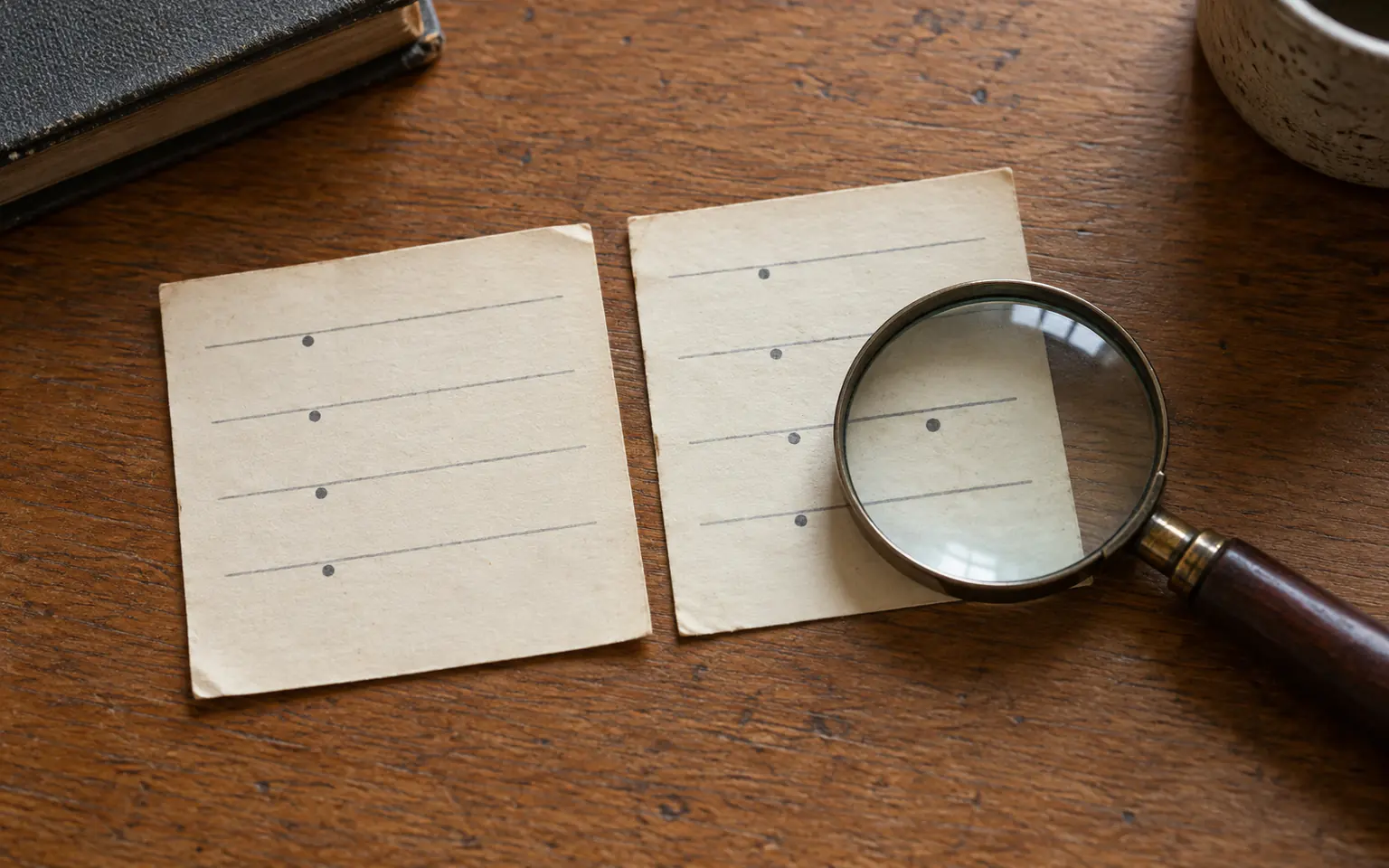
Two horoscopes come back with the same birth star on both sides. Somebody says the word Nadi, somebody else says Rajju, and within a few minutes a specific arithmetic fact has turned into a general verdict about whether the marriage should happen.
The fact is real, and it is narrower than the verdict. What follows is which rules it actually triggers, which it does not, and where the traditions part company.
What does “same nakshatra” actually mean here?
Usually one of three different situations, which families tend to describe with the same phrase. Separating them first saves a great deal of argument, because they trigger different rules.
The first is a shared nakshatra with different padas. The second is a shared nakshatra and a shared pada, which is a narrower coincidence. The third is a shared rashi — the Moon sign — without a shared star, which is a genuinely different question and is covered further down.
All three come from the same underlying quantity: where the Moon sat in the sidereal zodiac at each birth, computed from a birth date, time and place against a published ephemeris. We use the JPL DE440 positions cross-checked against the Rashtriya Panchang, and you can see which star and pada a set of birth details actually produces in the nakshatra finder.
It helps to know how the three levels nest, because the vocabulary moves between them constantly. The zodiac is divided into twenty-seven nakshatras; each nakshatra is divided into four padas; and the twelve rashis cut across that division rather than lining up with it, so a single rashi contains more than two whole nakshatras and part of another. A shared rashi is therefore a much weaker coincidence than a shared nakshatra, and a shared pada is much stronger than either.
That nesting is also why the same phrase produces such different reactions from different relatives. Somebody thinking in signs hears a mild coincidence. Somebody thinking in stars hears the finding that costs the largest block of points in the system. Neither is confused; they are describing different levels of the same arrangement.
Which rules fire when the star is shared?
Nadi, always, under the standard table. Rajju, in southern practice. Gana, not at all — and that surprises people.
Nadi is the one usually meant. Each nakshatra belongs to one of three nadi groups, so two people born under the same star are necessarily in the same group, and the standard Ashtakoota table awards no Nadi points in that case. Eight points is the largest single block in the thirty-six, which is why the total tends to drop sharply and why this particular finding gets so much attention. What it is not is a statement about health, fertility or children, and the medical claim attached to it does not follow from the arithmetic.
Rajju is a separate test applied in Tamil and Kerala practice, grouping the nakshatras by a body-part scheme. It matters here because it can refuse a pair independently of the total — a northern report may accept a match that a southern one rejects on this rule alone, without either being calculated wrongly. That divergence is set out in why Rajju is absent from northern reports.
Gana is the one people expect to fire and it does not. Each nakshatra is assigned to a gana, so two people sharing a star share a gana, and the tables treat a matching gana as agreement. The same-star case scores well there.
Two further rules are worth naming because families sometimes attach them to this situation and they do not belong to it. Bhakoot reads the Moon signs rather than the stars, so it responds to a shared rashi and not directly to a shared nakshatra. Yoni compares an animal classification assigned to each star; two people in one nakshatra share that classification, and the tables treat a matching yoni as full agreement rather than as a fault. Neither rule is the reason a same-star pairing scores low.
The reason Nadi carries eight points at all is worth a sentence, because it explains why this finding dominates the conversation. The eight kootas are not weighted equally: Varna is worth one point, Nadi is worth eight, and the rest sit between. So a single component decides nearly a quarter of the available total, and losing it moves a pair further than any other single result can. A same-star couple is not accumulating many small faults. They are losing one large block and keeping the rest.
Does the pada change the answer?
Not for Nadi under the standard table, and possibly for everything else. This is where a family conversation often stalls, because one relative has heard that differing padas resolve it and another has heard that they do not. Both have heard something real.
Nadi is a property of the nakshatra as a whole in the common table, so two people in different padas of the same star remain in the same nadi group and the points remain unawarded. That is why a pada difference does not change the total by itself.
What a pada difference does do is satisfy several named cancellation conditions. The classical and modern-authority literature records conditions addressing precisely this pattern — differing padas, differing rashis within the shared star, and a small number of other placements. Whether a given one applies is a checkable question rather than a matter of opinion, and every condition we publish carries the text it comes from in the cancellation reference.
This is the step most worth taking before anything else, because it is free and it frequently ends the discussion. A dosha that the tradition itself sets aside does not need to be argued about, remedied or purchased around.
There is a related situation worth separating here, because it is the strongest version of the coincidence: the same nakshatra and the same pada. The tables do not add a further penalty for it — Nadi has already withheld its points — but it does remove the pada-difference route through several cancellation conditions, so a family that was relying on one of those will find it unavailable. It is worth establishing early rather than discovering after a cancellation has been assumed.
One more thing about padas is worth knowing before a conversation, because it is frequently misremembered. A pada is a quarter of a nakshatra, which the Moon crosses in a few hours rather than a day. That makes it considerably more sensitive to a birth time than the star itself, so a pada-based cancellation claimed on a remembered hour rests on weaker ground than the shared star it is being used to set aside. Where a cancellation depends on a pada difference, the birth times behind it deserve a second look.
What if the rashi matches but the star does not?
A different question, and generally a friendlier one. Because each rashi spans more than two nakshatras, two people can share a Moon sign without sharing a birth star at all.
The rule that reads the sign is Bhakoot, which scores the distance between the two Moon rashis. The same-sign case is not one of the distances the rule objects to; it is generally scored as agreement. Families who arrive braced for a problem here are often reacting to a word they heard applied to a different situation.
Vashya and Graha Maitri also read the sign, and Graha Maitri compares the lords of the two signs — which, for two people in the same rashi, means comparing a lord with itself. The conventions differ on how that is scored, and that disagreement is documented in the two Graha Maitri conventions.
The same-sign case has one practical consequence that is easy to miss. Because Vashya, Bhakoot and Graha Maitri all read the rashi, a shared sign tends to move three components at once, in the same direction. A total that looks unusually high or unusually flat for a pair often has a shared rashi underneath it, and knowing that explains the shape of the scoresheet better than reading each koota in isolation.
A word about how this lands emotionally, since the arithmetic is the easy part. A shared birth star is often the first thing a family finds that they can name, and it arrives with a vocabulary that sounds like a diagnosis. Nothing in the tables supports that register. A koota result is a classification relationship between two computed positions — a statement about where two Moons were, compared against a table somebody wrote down. It is not a finding about either person’s character, health or suitability, and it does not become one by being repeated with more concern.
How do the traditions differ on this case?
Enough that the same two charts can be accepted and refused without anybody making an error. The same-star case is one of the clearest examples of the divergence this site was built to show.
A northern Ashtakoota reading applies the standard nadi table, loses the eight points, and then asks whether the remaining total clears the conventional acceptance line and whether a cancellation applies. A Tamil ten-porutham reading may not reach the total at all if Rajju refuses first, since some vetoes are treated as outweighing any score. The modern-authority literature, including works such as Raman’s Muhurtha, records its own exceptions that not every practitioner recognises, and the classical material collected under the Brihat Parasara Hora Sastra tradition is read differently by different schools.
We computed all five side by side rather than averaging them, because an average of five incompatible verdicts is not a sixth verdict — it is a number with no source. Seeing which method produced which answer is usually more useful than being handed a single one, particularly when two families follow different ones.
There is a second axis of divergence beyond which rules are applied, and it decides more cases than people realise: whether a rule is treated as a deduction or as a veto. A tradition that treats Nadi as a deduction subtracts its points and lets the remaining total speak. A tradition that treats it as a veto stops there, and no total can overturn it. Those are not different arithmetic; they are different constitutions, and the same scoresheet reaches opposite conclusions under them. Which rules a tradition allows to veto is documented in the veto reference.
This is why asking “what is our real score” rarely resolves a same-star disagreement. Both sides may already agree on the number. What they disagree about is whether one component is permitted to end the conversation, and that question is answered by a school of practice rather than by a calculation.
What should you check, and in what order?
Identify the rule, confirm the inputs, check the cancellations, then decide what any of it should mean. In that order, because each step can make the next one unnecessary.
Start by asking which rule the objection is actually about, in those words. Nadi, Rajju and a general unease about similarity are three different things, and the person raising it can usually name which one once asked. If they cannot, that is worth knowing too, and it is not a hostile question — a practitioner who applied a rule can name it.
Then confirm the inputs, because a shared star is exactly the kind of finding a small input error can invent. Nakshatra boundaries are crossed by the Moon regularly, and a birth time recorded from memory, or a historical time-zone offset applied wrongly — the time zone database exists because those offsets have changed — can move a star by one position. Two charts that appear to share a nakshatra may not.
It is worth being specific about how an input error produces this exact finding, since it is the failure mode with the cleanest fix. The Moon crosses a nakshatra boundary roughly once a day, so a birth time that is wrong by a couple of hours can place somebody in the neighbouring star. If one of the two charts is sitting near a boundary, a shared nakshatra may be an artefact of a remembered time rather than a fact about either person — and the same error can equally hide a genuine shared star. Checking costs nothing and settles it either way.
Then check the cancellations, which is free and frequently decisive. If one applies under the tradition the objecting family follows, the finding has been set aside by that tradition rather than by you, which is a much easier thing to report back than an argument about whether the rule should matter.
And then, whatever the arithmetic returned, keep it in proportion. A koota table describes a relationship between two computed positions. It does not describe two people, it does not measure whether they can build a life, and the considerations that actually shape Indian marriages — documented in research such as Banerjee and colleagues on mate selection — sit almost entirely outside it.
Questions people ask
Can two people born under the same nakshatra marry?
The traditions do not agree, which is the honest answer. The same-star case reliably costs the Nadi points under the standard table and may trigger a Rajju objection in southern practice, while several documented cancellation conditions address precisely this pattern. Which rule your family follows decides the verdict, not the fact itself.
Is sharing a birth star automatically Nadi dosha?
Under the standard nadi table, yes — a nakshatra belongs to one nadi group, so two people in the same nakshatra are in the same group and the eight points are not awarded. That is arithmetic rather than a prediction, and it says nothing about health, children or anything else.
What if we share the nakshatra but have different padas?
It depends on which rule is being applied. Nadi is a property of the nakshatra, so different padas do not change it under the standard table. Several traditions treat differing padas as a recognised cancellation condition, and some southern practice reads Rajju differently across padas.
Our Moon signs are the same but our stars are different. Is that a problem?
That is a Bhakoot question rather than a Nadi one, and the same-sign case is generally scored as agreement rather than as a fault. It is worth separating the two, because families often use one word for both situations.
Does sharing a star mean we are too similar?
That reading is common and is not what the rule says. The tables describe a classification relationship between two positions; they do not describe two personalities, and nothing in the calculation establishes that two people are alike or that similarity would be a problem if they were.
Sources
Claim-level links appear in the article; URL-derived IDs keep each full reference identifiable if this list is reordered.
- DR-4XC192 Brihat Parasara Hora Sastra — scanned editions — Internet Archive, various printings
- DR-1U6XF3T B. V. Raman, Muhurtha (Electional Astrology) — scanned editions — Internet Archive, various printings
- DR-30WG0O Planetary and Lunar Ephemerides DE440 and DE441 — NASA Jet Propulsion Laboratory, Solar System Dynamics, 2021
- DR-DDY8TY Rashtriya Panchang and the Indian Astronomical Ephemeris — Positional Astronomy Centre, India Meteorological Department, 2025
- DR-9AH1WP Time Zone Database — Internet Assigned Numbers Authority, 2025
- DR-1F6U0ET Marry for What? Caste and Mate Selection in Modern India — American Economic Journal: Microeconomics, 2013
Use the evidence
Check it on your own chart
These tools apply the same named rules described above. They are free, require no sign-up, and store nothing.