Where we stand · Evidence-led explainer
Whose birth details are those?
Is online kundli matching safe? What the free tools keep, what a paid report has to keep, and whether you should enter a partner’s birth details at all.
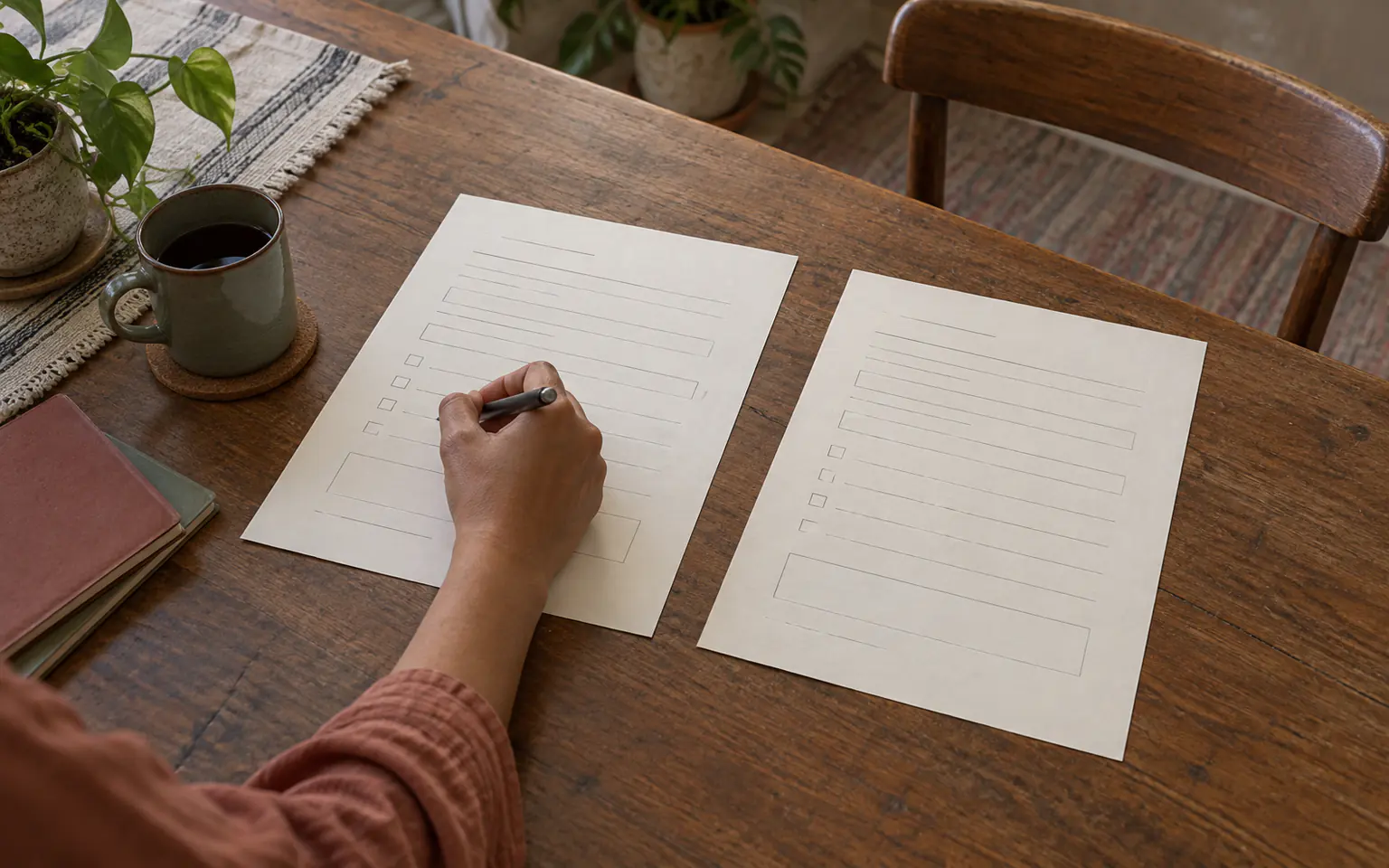
There is a moment, somewhere between the second and third field of a matching form, where a reasonable person hesitates. The date is theirs to give. The place is theirs to give. The birth details on the other side of the form belong to somebody who is not in the room.
That hesitation is worth taking seriously rather than clicking through, and it deserves a straight answer about what actually happens to what you type.
Is online kundli matching safe?
It depends almost entirely on what the site does with the details after it answers, and that is a question you can ask before you type anything. The calculation itself is arithmetic on positions; there is nothing inherently risky about it. The risk lives in retention, in reuse, and in who eventually reads the output.
Three questions separate the safe cases from the rest. Does the tool keep what you entered after it has answered? Does it need an account, and if so what else does that account accumulate? And is the result a private answer on your screen, or a document that will be shared with people who were never asked?
Those questions are answerable about any site, including this one, and a site that cannot answer them plainly has given you the answer.
It is also worth separating two things that get bundled together under the word safe. One is security: whether what you send can be intercepted or stolen. The other is purpose: what the site intends to do with it even when nothing goes wrong. Most published advice covers only the first, which is the smaller risk in this category. A matching site that never suffers a breach can still keep a chart forever, join it to an email address, and use it to sell you something in eighteen months.
There is a third thing people rarely count, and it is the one specific to matchmaking. The output is about two people, but only one of them is at the keyboard. Whatever answer you get, the other person’s date, time and place are now written down somewhere they did not choose. That is true even when the site behaves impeccably.
What do the free tools keep?
Nothing. Every calculator here computes on the request and returns the answer with it. There is no account, no saved chart, no history and no profile, which is why none of the tools ask you to register — there would be nothing to register for. Refreshing the page ends the result, and the details that produced it are not waiting anywhere to be recovered.
That is a design decision rather than a courtesy. A stored chart is an asset somebody has to protect forever, and the cheapest way to protect a second person’s birth details is not to be holding them. It also means the free surface of this site cannot build a profile of you across visits, because it has nothing to join visits together with.
The positions the calculations work from are public astronomical data — the JPL DE440 ephemerides and the IANA time zone database — not anything derived from previous visitors. Nobody’s chart contributes to anybody else’s answer.
One detail people ask about specifically: the place field. Choosing a town from a list rather than typing it freely is not a data-collection habit — it is how a location becomes a latitude, a longitude and a historical time-zone offset precise enough to compute an ascendant. The list is a fixed reference table shipped with the site. It does not look anything up about you, and it does not learn from what visitors choose.
What does a paid report have to keep?
More, and for a while, because a document that cannot be re-checked or re-sent is not much of a document. This is the honest asymmetry between the free tools and the paid one, and it should be a separate decision rather than something that follows silently from running a free check.
A report has to hold the birth details it was computed from, because they are printed in it — that is what makes the calculation auditable by you, by your family or by another astrologer. It has to exist long enough to be delivered and re-delivered if an email goes astray, and long enough for a refund or a correction to be honoured. What it is kept for, how long, and how to have it erased are set out in the privacy policy, and erasure can be requested without giving a reason.
There is one limitation worth knowing before you ask for erasure rather than after: deleting the record also removes the ability to re-check or re-send that report. Save the document first.
The other half of a paid transaction is the payment itself, and it is worth separating from the astrology. Card and bank details never reach us; they are handled by the payment gateway, and what comes back is a confirmation and a reference. The identity and grievance details a seller must publish under the Consumer Protection (E-Commerce) Rules are on the legal pages precisely so that a buyer can see who is answerable before deciding to become one.
Delivery is part of retention, and it is the part people forget. A report arrives as a private link rather than an attachment, which keeps the document out of a mail provider’s indexing and makes it possible to withdraw. The link is not listed in the sitemap and carries a header telling crawlers to leave it alone, so it will not surface in a search for either person’s name. What it cannot do is control who the recipient forwards it to, which is a human decision rather than a technical one.
The same reasoning explains a small refusal at the other end of the process. We do not ask anyone to upload a birth certificate or a hospital record, and no calculation here needs one. A scan of an identity document is a much heavier thing to hold than a date and a town, and a site that asks for it should be able to say precisely why.
Can I enter someone else’s birth details?
Technically yes, and that is exactly why it is worth pausing. No form can tell whose details it has been given, so the decision sits with you rather than with the software, and the software should say so instead of pretending the question does not arise.
The distinction that matters in practice is between a private check and a circulated document. Running a free calculation to satisfy your own curiosity is a small act with no residue — nothing is stored, nothing is sent, nothing outlives the page. Buying a report about two people and forwarding it to relatives is a different act. It creates a durable document about somebody, and it will be read by people who were never asked whether it should exist.
Our own checkout asks you to confirm that the second person knows their details are being used, and that confirmation is not a formality we can verify. It is there because the alternative is a form that quietly assumes a buyer speaks for both people, which is the assumption this whole category tends to make.
It is worth being honest about how these documents travel, because that is where the real exposure sits. A matching report is rarely read once and closed. It is forwarded to a parent, shown to an astrologer for a second view, discussed among relatives, and sometimes kept for years and produced again during a later conversation. Every one of those steps carries the second person’s birth details along with the verdict, and none of them is controlled by whoever bought the report.
That is not an argument against buying one. It is an argument for the person concerned knowing it exists, because they are the only one who can decide whether they want a document about their chart circulating in somebody else’s family. The version of this that goes wrong is not a data breach. It is a report produced without telling anybody, and then quoted at them.
There is also a plainer reason to ask them. A birth time you were told by a third party is frequently wrong, and a wrong time changes the answer. The person whose chart it is has the best chance of getting it right.
A useful habit, before entering anybody’s details anywhere: look for the three answers rather than for reassuring language. Sites that keep nothing tend to say so plainly, because it is easy to say. Sites that keep a great deal tend to describe their practices in the abstract — improving your experience, personalising results — without naming what is stored or for how long. The vagueness is the finding.
The same test applies to the free-versus-paid boundary. A calculator that requires an account before it will show a result has decided that your identity is part of the price, and it is fair to ask what the rest of the price is. We publish the full sample report and every calculator without a login for the same reason we store nothing: anything else would need explaining.
What does Indian law expect here?
That birth details are personal data, that people are told what is being done with them, and that the obligation sits with whoever collects them. The Digital Personal Data Protection Act, 2023 is built around notice and consent for exactly this kind of processing, and the older reasonable security practices rules already required disclosure and reasonable safeguards.
The Act’s substantive consent provisions are being brought into force in stages, so the position for a small Indian publisher is still settling. We would rather build to the standard now than argue later about which clause had commenced, which is why the free tools store nothing at all rather than storing something defensible.
We are not going to summarise a statute as though this page were legal advice. Two practical implications are worth stating anyway. The first is that a site processing your details owes you a notice you can actually find and read, not a link buried under a paywall. The second is that a right of erasure is only meaningful if there is a published route to use it, which is why ours is a page rather than an email address you have to hope somebody reads.
A birth record itself, incidentally, is a separate document with its own regime under the Registration of Births and Deaths Act. Nothing on this site is a substitute for it, and no calculator should ask you to upload one.
One asymmetry in the law is worth knowing because it cuts against the intuition most people have. The obligations fall on whoever collects and processes the data, not on the person it describes, and they do not disappear because the data arrived from a third party rather than from the person themselves. A site that receives a partner’s birth details from you is still processing that partner’s personal data. That is a reason for sites to be careful about what they retain, and a reason for you to prefer the ones that retain little.
It also means the fair reading of your own position is narrower than it feels. You are not doing something prohibited by entering a partner’s date of birth into a calculator that stores nothing. You are doing something worth telling them about if it is going to produce a document, because at that point the thing being created outlives the conversation you had about it.
How do you ask without making it strange?
By asking for a date, a place and a time rather than for permission to investigate somebody. The request feels heavier than it is. What you need is roughly what anybody tells a colleague organising a birthday, plus the town and, if it is known, the hour.
Timing helps as much as wording. Asking during an early conversation, framed as something your family does, lands very differently from asking after a report has already been produced and someone has reacted to it. The second version turns a routine request into a disclosure that something has been done without them.
It also helps to say what it is for and what it is not for. “My family wants the charts matched and I would rather use your real details than a guess” is a complete explanation, and it quietly rules out the interpretation people actually fear — that a verdict is being sought about them behind their back. If the honest answer is that a family member has asked for this and you are not sure you agree with the exercise, saying that is better than concealing it.
If they ask what will happen to the details — a fair question, and the one this whole page is about — the answer is short enough to give from memory. A free check keeps nothing and ends when the page is refreshed. A paid report keeps what it prints, for a stated period, with a published way to have it erased. Being able to say that without hedging is worth more to the conversation than any argument about whether the tradition is worth following.
If the time is genuinely unknown, that is workable and does not require anybody to invent one. Star-based matching runs from the nakshatra rather than the clock, and the birth-time narrower will show which readings hold across an entire unknown day. What we computed there is a range and not a time, which is the honest form of the answer.
A last practical note for the situation where you are not the one asking. If a family member has already run a match on you and shown you the result, you are entitled to ask the same questions of it that you would ask of any report: which birth details were used, which nakshatra and lagna they produced, and which tradition’s rules were applied. Those are questions about a calculation, not a challenge to anybody’s beliefs, and reading a matching report sets out how to put them.
None of this needs to become a negotiation about belief. Plenty of couples end up in a position where one of them takes the matching seriously and the other does not, and the request still has to be made. Handing over a date and a place is not an endorsement of the method, and it is reasonable to say as much while doing it.
And if the person says no, that is an answer too. It is theirs to give, and a refusal to hand over personal data to a stranger’s family is not a finding about compatibility — it is not something a chart could establish in the first place.
Questions people ask
Do the free calculators store the birth details I enter?
No. A calculation runs on the request and the answer comes back with it; nothing is written to an account or a report, and refreshing the page ends the result. That is why none of the free tools ask you to sign in — there is nothing to sign in to.
Is it wrong to check a prospective partner’s chart without telling them?
It is their personal data, so the honest position is that it is theirs to give. A private curiosity check is not the same as building a document about somebody and circulating it in a family. If the result would ever be shown to anyone else, they should know it exists.
What happens to the birth details in a paid report?
They are used to compute the report, they appear in the report itself so the calculation can be re-checked, and the report is delivered by a private link. The privacy policy sets out the retention period and the route to have it erased, and erasure can be requested without explaining why.
Can I ask for my data to be deleted after buying a report?
Yes. There is a published erasure route and it does not require a reason. The one honest limitation is that deleting the record also removes our ability to re-check or re-send that report later, so it is worth downloading the document first.
Is a matrimonial site’s matching feature the same thing?
Not necessarily. A platform that already holds a profile may retain, reuse or display results in ways a standalone calculator does not. The question worth asking of any of them, including this one, is what is kept and for how long — and the answer should be findable without contacting anybody.
Sources
Claim-level links appear in the article; URL-derived IDs keep each full reference identifiable if this list is reordered.
- DR-1M7MSQD The Digital Personal Data Protection Act, 2023 — Ministry of Electronics and Information Technology, Government of India, 2023
- DR-1VW0QPN Information Technology (Reasonable Security Practices and Procedures and Sensitive Personal Data or Information) Rules, 2011 — Ministry of Electronics and Information Technology, Government of India, 2011
- DR-1FH3ARO Registration of Births and Deaths Act, 1969, as amended — Government of India, 2023
- DR-1XDKAFA Consumer Protection (E-Commerce) Rules, 2020 — Department of Consumer Affairs, Government of India, 2020
- DR-30WG0O Planetary and Lunar Ephemerides DE440 and DE441 — NASA Jet Propulsion Laboratory, Solar System Dynamics, 2021
- DR-9AH1WP Time Zone Database — Internet Assigned Numbers Authority, 2025
Use the evidence
Check it on your own chart
These tools apply the same named rules described above. They are free, require no sign-up, and store nothing.