Regional systems · Evidence-led explainer
10 Porutham: the Tamil system, explained properly
Learn the ten poruthams used in Tamil marriage matching, their weights and grades, and how this Dashakoota system differs from North Indian Ashtakoota.
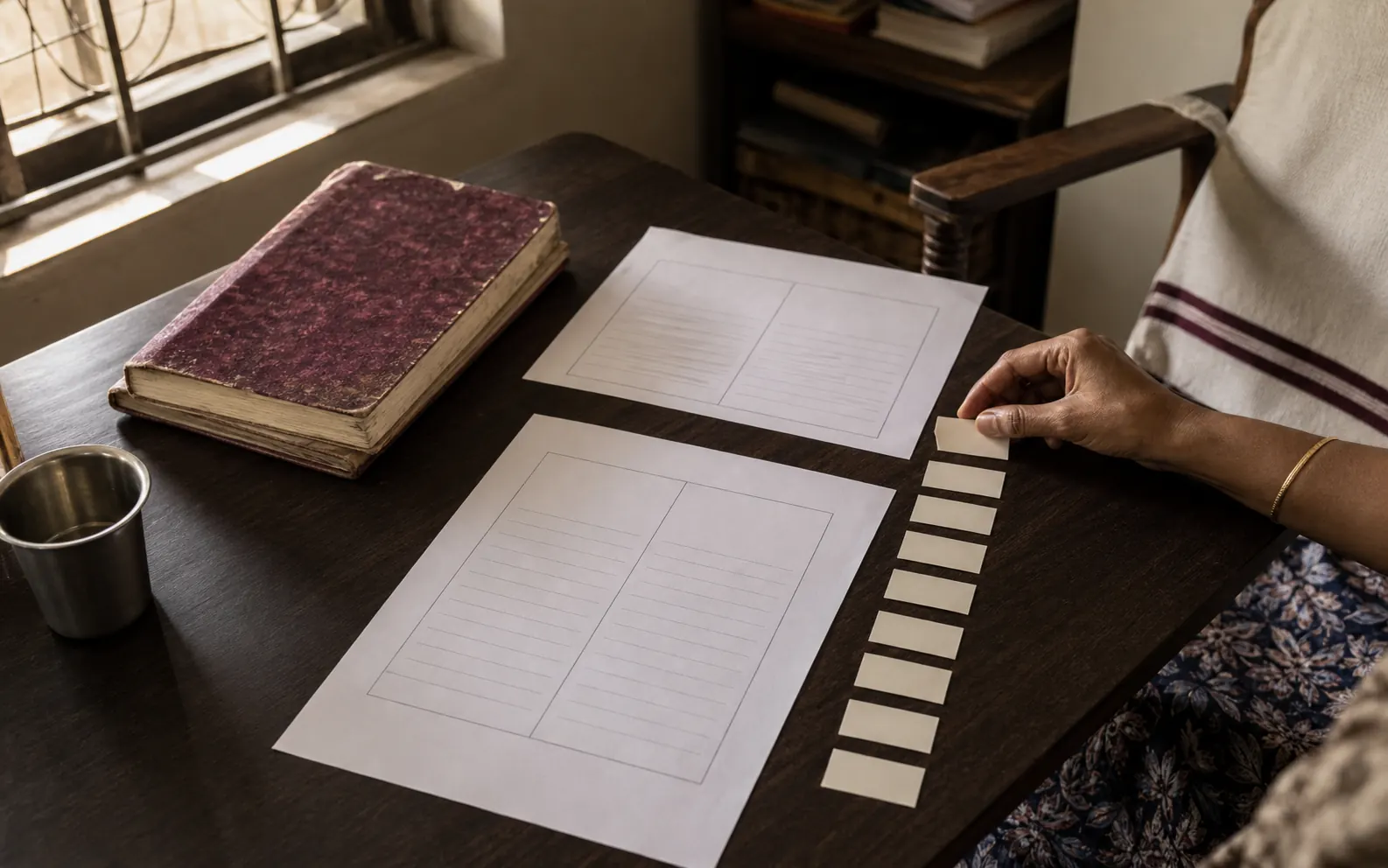
The ten poruthams are not the eight kootas with Tamil names and two extras added — they are a separate system that grades findings instead of adding points, and two of the ten refuse a match outright. A Tamil matching report does not usually end in a number out of thirty-six. It ends in a word. Uttamam, madhyamam or adhamam, printed above a list of ten named tests, each marked as agreeing or not agreeing.
Families who have held both kinds of report assume the ten are the eight relabelled. That assumption is the first thing to take apart, because it is what makes a Tamil refusal look like a scoring error rather than a different instrument giving a different reading.
What does a ten-porutham report actually say?
It says which of ten named tests agreed, what grade each one took, and what the set adds up to as a word. The ten are Dina, Gana, Mahendra, Stree Deergha, Yoni, Rasi, Rasyadhipathi, Vasya, Rajju and Vedha, and a printed report gives them in roughly that order with a mark beside each.
Look at what is missing from that list. There is no nadi line. There is no varna line. Graha maitri appears, but under the name Rasyadhipathi and with a different pass rule. Meanwhile Dina, Mahendra, Stree Deergha, Rajju and Vedha have no northern counterpart at all — not a low score, not a footnote, simply absent from the other system’s arithmetic.
The grade words matter more than families expect. Madhyamam is not a failure. In most Tamil practice it is the middle band, and a great many matches proceed on it. A family reading madhyamam as “did not pass” is importing a pass-mark habit from the northern eighteen-point convention, where a number either clears a line or does not. The southern report was never structured that way, and each of the ten individually can also come back madhyamam rather than as a tick or a cross.
You can run the ten against two birth stars on our ten porutham calculator, which prints each test with the source its rule comes from rather than asserting the result.
Why does Dashakoota grade where Ashtakoota adds?
Because the two systems answer different questions: one asks how much compatibility there is in total, the other asks which specific tests were satisfied. Ashtakoota allocates one point for varna, two for vashya, three for tara, four for yoni, five for graha maitri, six for gana, seven for bhakoot and eight for nadi. Then it adds. A component can be lost entirely and the total can still clear eighteen, because everything lands in the same pot.
Dashakoota does not have a pot. Each porutham is graded on its own and the set is read. The convention most almanacs and matching services use counts the agreements: eight or more is uttamam, six or seven is madhyamam, five or fewer is adhamam.
That difference is not cosmetic, and it produces a specific asymmetry. In the northern system a catastrophic nadi result costs eight points and the rest of the chart can, in principle, make most of it back. In the southern system there is nothing to make back. A porutham that came out adhamam sits on the page as adhamam, and the report says so beside nine other findings.
There is a second consequence of grading, less obvious and more useful to a family. A graded finding keeps information that a total throws away. Ashtakoota compresses eight readings into one integer, and once that integer is written down there is no route back to the components that produced it — two couples on nineteen points can have nothing in common. Dashakoota never compresses. The ten findings stay ten findings on the page, each carrying its own grade, so anybody holding the report can see which tests carried the reading and which ones did not. Whatever else the southern system is, it is the more auditable of the two, and that is a property of the format rather than of the astrology.
The ten are read as a set of findings. They are not eight kootas with two more added to the total.
Worth noticing which way the leniency runs, because the folklore has it backwards. The southern system is usually described as stricter, and on the vetoes it is. On the ordinary tests it is markedly more forgiving: six agreements out of ten is a passing band, and a great many couples who would sit below eighteen on a northern total land comfortably in madhyamam. The strictness is concentrated in two places rather than spread across the report.
There is a practical consequence that families run into constantly. When a Tamil astrologer is asked “what is our score”, the honest answer is that there is no score, and the count out of ten that gets offered instead is a convention layered on top of the system rather than something the older sources compute. It is a useful summary. It is not the reading.
Where does the list of ten actually come from?
From the South Indian muhurta literature and the regional almanacs that abbreviate it, not from a single canonical verse listing ten. This is the part most English explanations skip, and skipping it makes the ten look older and more fixed than they are.
The kuta material itself is ancient and widely shared: the Brihat Parashara Hora Shastra carries compatibility rules that both systems draw on, and Kalyana Varma’s Saravali carries more. What differs regionally is the selection — which tests are pulled forward, in what order, with what weight. Kalaprakasika, the South Indian electional handbook, is one of the routes by which the southern selection reached print, and Daivajna Rama’s Muhurta Chintamani is another.
Because the list is a selection, the lists vary. Some Tamil sources run twelve poruthams rather than ten, adding Varna and Vasiya as separate lines. Kerala practice keeps a related but not identical set. B.V. Raman, writing in Muhurtha, discusses the kutas without treating any regional count as the definitive one, and he is explicit that authorities differ.
Worth arguing with: the tidy claim that the ten poruthams are the ancient Dravidian system and the eight kootas are the northern one is too clean to be true in either direction. Both selections draw on shared Sanskrit material. What is genuinely regional is the practice — which tests a working astrologer in Madurai runs, in what order, and what he does with a bad one. That is a real difference and it does not need an invented history to be real.
Which poruthams are treated as primary, and which as secondary?
Tamil practice usually treats Dina, Gana, Mahendra, Stree Deergha and Yoni as the primary set, with Rasi, Rasyadhipathi and Vasya as supporting, and Rajju and Vedha standing outside the ranking entirely. The ranking is not printed on most reports, which is why a madhyamam verdict can mean two very different things.
Six agreements out of ten reads as madhyamam whichever six they are. But six agreements that include four of the primary five is a different document from six agreements that are all supporting tests, and an experienced astrologer reads them differently even though the count is identical. This is the single largest gap between what a report prints and what the person reading it out to your family is actually weighing.
The sources also carry explicit substitution rules, which is a category northern scoring has no room for. The clearest is on Mahendra: the tradition holds that Mahendra suffices in the absence of Dina and Rasyadhipathi. One test standing in for two others is not something you can express by adding points, and it is one of the reasons the two systems cannot be translated into each other.
Raman goes further in the other direction and calls Rasyadhipathi the most important kuta of the set. Tamil almanac practice does not usually rank it that highly. Both positions are documented, both are held by serious practitioners, and a family is rarely told which one the astrologer in front of them holds.
The ranking also changes what a refusal means in the room. A failure among the supporting three is a finding an astrologer weighs against the rest of the page; a failure among the primary five is the thing the conversation will be about for the next hour. Families are handed the count and left to assume the ten are interchangeable, which is the one reading the tradition itself does not support: it named a primary set, it wrote substitution rules between specific tests, and it put two of the ten outside the ranking altogether. A count of ten equal items is a modern convenience laid over a system built out of unequal ones.
What else appears on a Tamil report besides the ten?
Usually three further tests that are not poruthams at all: a malefic-balance count, a dasha-timing check, and a Mars assessment run on the Tamil house list. Families who expect the report to be ten lines and find fourteen are not looking at padding. Those extra tests are part of southern practice and two of them can refuse on their own.
The malefic-balance test is papasamyam, and it is the one with no northern equivalent whatever. It counts malefic affliction on both charts and asks whether the two burdens are comparable, which means an afflicted chart is not refused for being afflicted — it is refused against a partner carrying much less. A manglik verdict is delivered about one chart; this one is delivered about a pair. The mechanism, both models of it, and the direction the comparison runs are in the papasamyam explainer.
The timing check is Dasa Sandhi, and it is the least discussed rule in the whole system. It asks how close the two partners are to a change of Vimshottari dasha period, on the reasoning that a marriage should not sit on top of two simultaneous transitions. The published windows differ by a factor of two — six months in the Tamil sources, twelve in the Kerala ones — and four stars are treated as exempt. A couple can therefore be inside the window for one astrologer and outside it for the next, on nothing but which almanac is open.
The third is chevvai dosham, the Tamil reading of Mars, which uses a house list and a set of reference points that do not match the northern manglik convention. It is not one of the ten and it does not enter the count, but it can end a discussion faster than any of them. We keep it as its own subject in the chevvai dosham piece because a family arguing about Mars is usually arguing about a different rule than they think they are.
So a report that says “seven poruthams agree” may be carrying three findings underneath that never appear in the count. Ask what else was run. The answer takes ten seconds and it changes what the count means.
Why can two of the ten refuse what the other eight cannot rescue?
Because Rajju and Vedha are blocking conditions rather than deductions, and a blocking condition is not a low score to be outweighed. This is the structural fact that makes the two systems irreconcilable by arithmetic, and it is the one families most often discover the hard way.
Rajju sorts the twenty-seven stars into five groups named for parts of the body and asks whether both partners fall in the same one. Vedha is a fixed table of star pairs held to obstruct each other. Neither produces a mark. In the readings that use them as vetoes, a same-group rajju stops the assessment, and a couple agreeing on eight poruthams is refused with the eight agreements still printed above the refusal.
Our engine includes all ten pass/fail results in the count and also reports Rajju and Vedha vetoes separately. A high count can therefore coexist with a veto; the total must not hide it. The full mechanism — the five groups, the nine-step pattern that produces them, and the exception Raman states — is in the piece on why rajju never appears in a northern report.
The distinction survives translation badly, which is why it causes so much trouble in a household holding both kinds of report. A deduction is a quantity and a blocking condition is a kind, and arithmetic can only be performed on the first. Ask what a same-group rajju is worth in points and the question has no answer in the system that raised it — not nought, not eight, no answer at all. Software that supplies one has not translated the finding; it has substituted a different finding that happens to fit in a column.
How far apart do the two systems actually land?
The systems can disagree, but the census is not a survey of cross-regional couples. We scored all 11,664 ordered nakshatra-pada pairings under five documented schools. There are a hundred and eight nakshatra-pada positions: this exhausts that discrete, equally weighted space, without measuring real-world prevalence or predictive accuracy.
Across that set the mean Ashtakoota total is 20.1 out of thirty-six and 66.7% of pairings clear the conventional eighteen-point line. The combined census flags 56.4% for at least one tested scoring, cancellation or system difference, or a veto. This is not a standalone North-versus-South disagreement rate; those component checks must be examined separately.
Two tables sit in both systems, which makes the overlap easy to overstate. Gana is worth 6 points in the northern arithmetic and falls to zero for 22.2% of pairings; Yoni is worth 4 and full marks are the rarest of any koota at 7.3%. The southern system reads the same two tables and grades them differently — Gana directionally, so that the same two temperament classes read differently depending on which partner holds which, and Yoni with the sex of the animal weighted, which most northern scoring ignores.
The overlap that does exist is also smaller than the shared vocabulary suggests. Rasi and Bhakoot both read the distance between two Moon signs and then disagree about what that distance means: Bhakoot zeroes six of the twelve distances outright and loses 7 points when it fires, while Rasi Porutham refuses three distances, treats the mutual seventh as the best case, and carries a directional reading in which the same gap has different fruits depending on which partner is counted from. Two tests, one input, unrelated verdicts.
None of this is evidence that either system is unreliable. It is evidence that they are two systems, developed separately, answering to different textual authorities, never reconciled with each other. And more families are caught between them than used to be: the economics literature on Indian mate selection, including Banerjee, Duflo, Ghatak and Lafortune’s study of caste and matching, describes a marriage market that has widened geographically while keeping its arrangement structure. Widen the market and you multiply the households consulting two traditions at once.
What do the schools that all use ten poruthams disagree about?
Thresholds and pass rules, mostly — disagreements about a number rather than about a principle. The ten are not uniform even among the practitioners who run all ten.
Four of the ten carry rival published settings. Stree Deergha has five thresholds in print for one count. Dina runs on a division for some schools and on an explicit list of favourable numbers for others, and the two published lists differ. Rasyadhipathi splits over what a neutral relation between the two sign lords does, with Kerala and Tamil practice on opposite sides. Vedha has two versions of its obstruction table. Rajju carries a stated exception and a rule limiting that exception, and one widely used implementation omits it. Each of those settings is set out source by source in the porutham-by-porutham reference, which is where the arithmetic belongs.
What matters for the shape of the system is how differently a graded reading absorbs that disagreement from a summed one. Change a threshold in the northern arithmetic and a total moves by a few points; the verdict shifts only for couples already sitting near the line, and everybody else keeps the same answer with a slightly different number. Change a threshold in the southern system and a named finding flips from agreeing to not agreeing. Nothing about it is partial. If the flipped test is one of the primary five, the whole character of the reading changes with it, and the count out of ten moves by a full point — which is a tenth of the entire scale, and enough on its own to cross the boundary between uttamam and madhyamam.
Every one of those positions is documented and carries a name. None of them is an error. Which means a couple can be refused in one street and accepted in the next with the same two birth details, and the difference is a line in a book that neither family will ever be shown.
What do the ten say about the published sample couple?
Seven of the ten agree, which grades as madhyamam — while the same two charts fall below the eighteen-point line in the northern system and get refused. The sample case on this site is Priya, born in Pune with the Moon in Ashwini, and Arjun, born in Chennai with the Moon in Purva Bhadrapada. Her family’s astrologer refused the match on nadi grounds.
Ashwini is the first star and Purva Bhadrapada the twenty-fifth, so the count from her star to his is twenty-five, and that count decides three of the ten on its own. Mahendra requires the count to be one of eight specific numbers and twenty-five is the last of them, so Mahendra agrees. Stree Deergha wants distance, and twenty-five clears every one of the five published thresholds, so it agrees under all of them — a rare thing on that test. Dina divides twenty-five by nine, gets a remainder of seven, and refuses; twenty-five is also absent from both versions of the Tamil favourable list, so the two routes agree on the refusal for once.
The rest: their Moon signs are Mesha and Kumbha, eleven apart, so Rasi agrees in the middle band. Her sign is under the sway of his on the vashya list but not the reverse, so Vasya agrees in one direction only. Rasyadhipathi puts Mars against Saturn, and because Saturn counts Mars an enemy the porutham comes back adhamam even under the more permissive of the two neutral conventions. Yoni pairs a horse with a lion, which is neither the same animal nor a sworn enmity, and takes one mark of four. Gana pairs a Deva bride with a Manushya groom, which the southern table grades as the middle case. Rajju puts her in the foot group and him in the navel group — different, so no veto. Vedha does not pair Ashwini with Purva Bhadrapada, so no obstruction there either.
Seven agreements, three refusals, no veto: madhyamam, the acceptable middle band. And their northern total is seventeen out of thirty-six, one point under the line, with all eight nadi points lost. The same two people, two competent readings, opposite conclusions — and the reason is that nadi is not one of the Tamil ten, while Dina, Mahendra, Stree Deergha, Rasyadhipathi, Rajju and Vedha are not in the northern thirty-six. You can put the two side by side yourself with the porutham tool and the eight-koota one.
Why do two matching apps give different porutham counts?
Because the defaults differ, and almost none of them are printed. Every implementation has to pick one setting from each of the contested parameters above, and then a policy for the two blocking conditions on top. Those choices are made once, in code, by somebody the family will never meet.
The policy on the vetoes is the one that changes verdicts most, because it is the one that is not a number. A program can treat Rajju as a veto, as an exception-bearing veto, as a nought-to-four score, as a term to omit, or as a line it prints and then contributes nothing for. All five behaviours exist in shipped software, and the last is both the strangest and the most common: the four tests with no northern counterpart are computed, displayed, and add nothing to the number printed underneath them, so the report shows the southern system and scores the northern one.
That failure is structural rather than careless. A points column is the wrong container for a finding that was never a quantity, and an engineer given ten graded findings and one integer field will fill the field. The result looks like a Tamil report and behaves like a partial northern one, and there is nothing on the page that tells a reader which they are holding.
We take the opposite approach and make the choices visible: every rule our engine runs cites the text it came from, the contested ones are exposed as switches rather than baked in, and where two documented readings disagree the report shows both instead of picking. That is not a claim to be more accurate. It is a claim that a family is entitled to see which line in which book produced the sentence that changed their year.
How much of this depends on an accurate birth time?
Less than a manglik verdict does, and more than families are usually told. This is worth separating out, because a great many Indian birth times are family memory rather than a certificate, and the honest answer differs test by test.
Seven of the ten need only the Moon’s nakshatra and rashi. The Moon covers roughly thirteen degrees a day, so it spends about a day in each star — which means an hour of doubt in the birth time almost never moves the star, and a whole day of doubt certainly can. If the recorded time is out by an hour, those seven tests are stable. If nobody is sure which of two dates it was, nothing in the report survives.
Padas are a different matter. A star divides into four padas of about six hours each, so an hour of uncertainty can move the pada, and the pada is load-bearing in two places: Dina carries pada-dependent exceptions at three of its counts, and the same-sign case in Rasi turns on which partner’s star comes first. A report that quotes a pada from a remembered time is quoting a figure with more confidence than the input carries.
The ascendant is the fragile one. It changes sign roughly every two hours, so papasamyam and any Mars assessment — both of which read houses from the ascendant — can flip on a birth time that is wrong by ninety minutes. That is the same sensitivity a northern manglik check has, and it is why the extra tests on a Tamil report are less robust than the ten themselves.
There is a quieter problem underneath all of it. A birth time recorded in 1994 has to be resolved against the local-time rules actually in force at that place and date, and those rules are historical data rather than arithmetic — the IANA time zone database is the reference the whole software industry uses for it. Get the offset wrong by half an hour and every house in the chart can shift.
What does a porutham verdict not tell you?
It tells you how two birth stars and two Moon signs sit against a set of regional tables, and nothing whatever about two people. Seven of the ten consume two star names and two Moon signs and see nothing else about the couple, which is the short version of a longer commitment set out in the things this site refuses to claim.
There is a limit in the count itself that is particular to this system and worth stating here. Seven out of ten and eight out of ten look like neighbouring results, and under the grade thresholds they are not neighbours at all — one is madhyamam and the other uttamam. Any threshold does that somewhere. What makes it sharper here is that the scale has only ten steps, so a single test changing its mind moves the reading a tenth of the way across it, and there is no partial credit anywhere in the system to soften the step.
The summary word is also younger than the thing it summarises. A system with no total had to invent one to answer “what is our score”, and the count that got invented treats ten unequal findings as ten equal ones. It is a serviceable shorthand between astrologers who both know what it conceals. It is a poor document to hand a family who do not, which is why a report that prints the ten findings with a grade and a source against each is a more honest object than the same report with a number at the top.
And the two systems cannot be reconciled by computing harder. A northern total and a southern set of findings answer to different texts, and no amount of recomputation converts one into the other — which is why both readings, printed side by side with the source named against each, is the most a document can honestly offer.
What should you ask when a porutham refusal arrives?
Four questions, each with a short factual answer, none of which requires challenging the astrologer’s judgement. That last point matters more than it sounds: a family that opens with a challenge usually gets a shorter conversation and less information.
- Which poruthams did not agree, by name. A count out of ten is not enough. A Rajju failure and a Vasya failure are different kinds of object and the report should distinguish them.
- Was any failure treated as a veto or as a lost mark? That is a decision the astrologer makes rather than a calculation he performs, and it determines whether anything else in the reading can bear on it.
- Which threshold was used for Stree Deergha, and does neutral pass for Rasyadhipathi? Both are documented choices with named sources on either side, and either one can be the whole of a disputed result.
- Were the primary poruthams among the failures? Six agreements that include the primary set read differently from six that do not, and the count alone hides which you have.
Ask for the working, too, not just the verdict. A porutham reading is ten short findings, each of which is a table lookup or a count between two numbers, and every one of them can be written on half a page. A family that receives the ten findings with the source named against each is in a position to take the same page to a second astrologer and get a comparable answer — which is the only way two opinions ever become comparable rather than merely contradictory. A verdict with no working behind it cannot be checked by anybody, including the astrologer who gave it.
If the refusal turns out to be Rajju or Vedha, a northern report the family may also be holding has nothing to say about it in either direction — it computed a total in which those terms never appeared. And if the refusal is papasamyam rather than a porutham, that is a different test again, with its own comparative logic and its own two irreconcilable models underneath it.
One more thing to check before a family concludes that somebody blundered. G.H. Visweswara set eight regional almanacs side by side on the same couples and found them returning different verdicts, from published tables, with no arithmetic error anywhere — his comparison is worth reading in full if the idea that two careful astrologers can disagree still feels like it must be somebody’s mistake. A ten-porutham reading and a thirty-six-point reading are further apart than any two almanacs on that list.
Questions people ask
How many poruthams should match for marriage?
The convention most Tamil almanacs and matching services use grades the count out of ten: eight or more agreeing is uttamam, six or seven is madhyamam, five or fewer is adhamam. Madhyamam is an acceptable band rather than a refusal in most practice, which surprises families who expect a pass mark.
Is 10 porutham the same as 36 guna matching?
No. They share four tables and disagree about everything else. The northern thirty-six weights eight components and adds them; the Tamil ten grades ten findings and reads them as a set, and two of the ten cannot be outweighed at all. Six of the ten have no counterpart in the northern arithmetic.
My family has a Tamil report and a North Indian report that disagree. Which one is wrong?
Probably neither. Each is an accurate account of what its own tradition concludes, computed from tables the other system does not contain. The disagreement is between the systems, and no recomputation resolves it. What you can get is both readings side by side, each naming the text it came from.
Sources
Claim-level links appear in the article; URL-derived IDs keep each full reference identifiable if this list is reordered.
- DR-1AAO7WB B.V. Raman, Muhurtha (Electional Astrology) — the kuta definitions, the Stree Deergha threshold and the rajju exception — Raman Publications, Bangalore, via the Internet Archive, 1948
- DR-Q4DHU3 Kalaprakasika, translated by N.P. Subramania Iyer — the South Indian electional handbook the porutham material descends through — Internet Archive (1982 edition scan), 1982
- DR-1RSDSRD Muhurta Chintamani of Daivajna Rama — the muhurta compendium the regional almanacs abbreviate — Internet Archive (Khemraj edition scan), 1600
- DR-K482ED Brihat Parashara Hora Shastra — the compatibility material the northern eight-koota table descends from — Internet Archive (public domain scan), 2021
- DR-1T0NVLF G.H. Visweswara, “Comparison of Panchangas for Horoscope Matching for Marriage” — eight almanacs set side by side on the same couple — Saptarishis Astrology, 2024
- DR-1F6U0ET Abhijit Banerjee, Esther Duflo, Maitreesh Ghatak and Jeanne Lafortune, “Marry for What? Caste and Mate Selection in Modern India” — American Economic Journal: Microeconomics 5(2), 2013
- DR-30WG0O JPL Planetary and Lunar Ephemerides (DE440/DE441) — the positional data every chart on this site is built on — NASA Jet Propulsion Laboratory, California Institute of Technology, 2020
- DR-9AH1WP IANA Time Zone Database — the historical local-time rules a birth time has to be resolved against — Internet Assigned Numbers Authority, 2026
Use the evidence
Check it on your own chart
These tools apply the same named rules described above. They are free, require no sign-up, and store nothing.