Regional systems · Evidence-led explainer
Papasamyam: how the South weighs the malefics
Learn the meaning of Papasamyam, how malefic influence is counted in both charts, and why Kerala and Tamil matching ask whether the two totals balance.
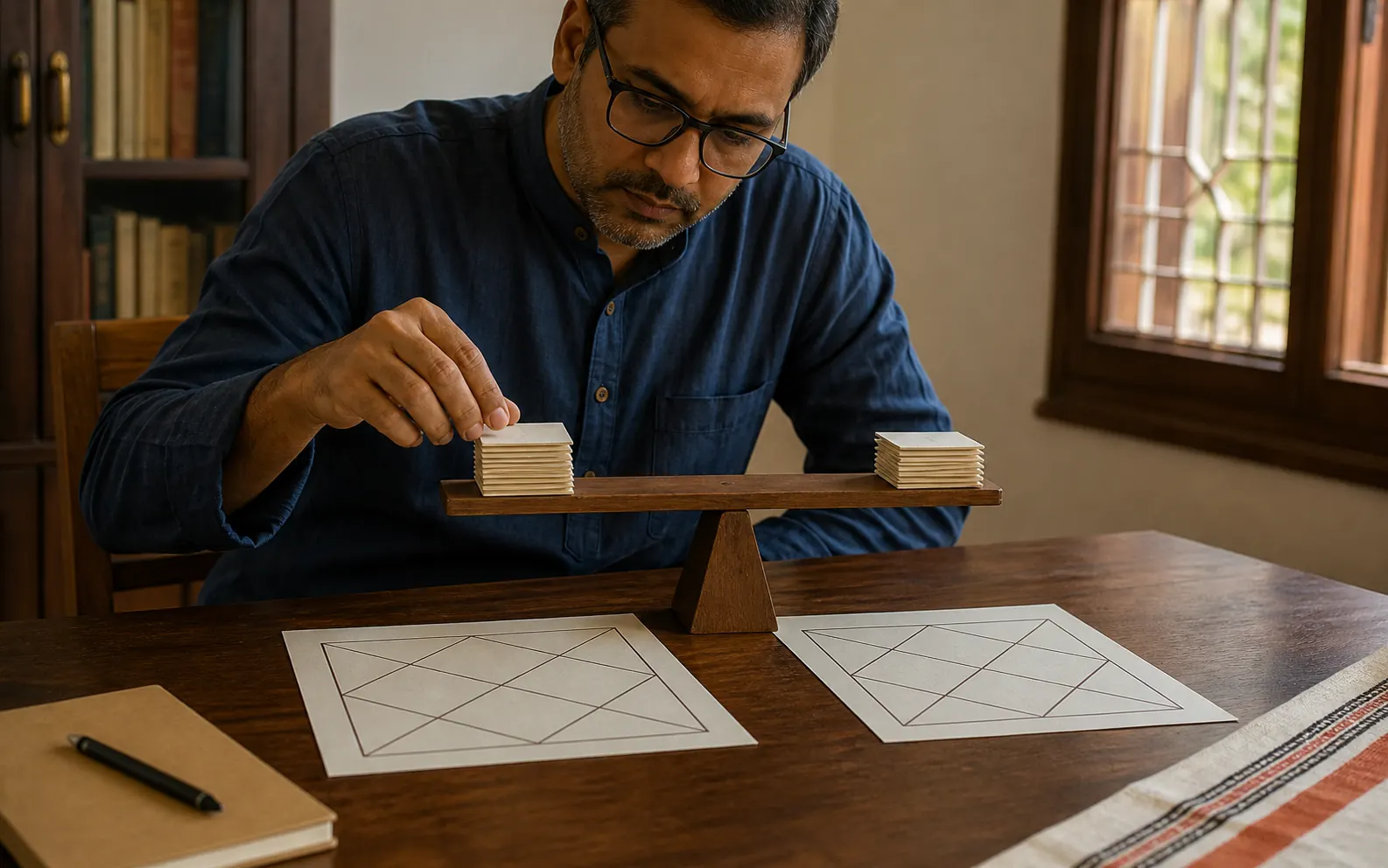
Papasamyam is a verdict about a pair rather than about a chart: it counts malefic burden on both sides and asks whether the two are comparable, so an afflicted chart is refused only against a partner carrying much less. A family in Chennai or Thrissur is told the charts were checked for papasamyam and the balance was not right. The word gets translated for a northern audience as the southern version of a manglik check.
That translation loses the only thing that matters about it. A manglik verdict is about one person’s chart and one planet. This is about two charts, five planets and a comparison — and the comparison can go the surprising way.
What is papasamyam actually testing?
Whether two burdens are of comparable size, which is a different question from whether either burden is heavy. The reasoning behind it is easy to state and worth stating, because it is more humane than the reputation the test has.
If affliction in a chart is held to bear on a marriage, then a heavily afflicted person matched to a lightly afflicted one is the case the tradition worries about. Two comparably afflicted charts are held to sit together. So the test does not ask “is this chart clean”. It asks “are these two the same weight”, and it answers with two numbers rather than one.
That structure produces a result families find counter-intuitive on first hearing. A chart carrying a great deal of malefic affliction is not refused by this test for carrying it. It is refused when the other chart carries much less. And the converse, which we come back to below, is the genuinely strange one: some readings treat an entirely unafflicted chart as the wrong partner for an afflicted one.
Northern practice has no equivalent. The eight-koota total examines star and sign relations and does not look at malefic placement at all, and the manglik check that runs alongside it is delivered chart by chart. That absence is part of why the regions part company so readily: run every possible star pairing under five documented schools and 56.4% of enumerated pairings trigger a tested difference or veto across the combined census checks — a figure computed over the whole population rather than a sample, and one that does not include the malefic axes at all, since those need real planetary positions and have to be measured separately. The structural comparison between the two regional approaches is set out in north versus south matching.
Which planets and houses does the simple count use?
Five malefics, six houses, three reference points, one point per hit — and that is the entire model most South Indian software ships. Its own documentation calls it equal point, equal weightage, which is an unusually honest name for a method.
The malefics are Mars, Saturn, Rahu, Ketu and the Sun. The afflicted houses are the 1st, 2nd, 4th, 7th, 8th and 12th. Every malefic sitting in one of those houses adds a point, and the houses are counted three separate times: once from the ascendant, once from the Moon and once from Venus. Both charts are counted identically and the two totals are compared.
Because each planet is checked against three reference points, one planet can contribute up to three points on its own, and frequently does. This is why papa totals run higher than families expect — a total in the high single figures is ordinary rather than alarming, and a number means nothing until it is set beside the other chart’s.
The house list itself repays a moment. The 7th is the house of the partner and the 8th is the house the tradition associates with the ending of things, so their presence needs no explanation. The 2nd is the house of family and speech, the 4th of domestic settledness, the 12th of loss and expenditure, and the 1st is the person. It is a coherent list, chosen for a marriage question rather than borrowed wholesale — and it differs from the northern manglik house list, which is where a family holding both reports first notices that the two are not the same test.
The question is not how afflicted a chart is. It is whether the two charts are afflicted to a comparable degree.
Two things about the simple model are worth flagging as choices rather than facts. Ketu counts as a full malefic here, and the classical model gives it nothing at all. And the Moon and Mercury are excluded from the malefic list entirely, which most sources agree on but not all — a waning Moon is treated as malefic in several classical contexts, including in Prasna Marga, and no papasamyam implementation we know of applies that.
Why does the count run three times over the same chart?
Because southern practice judges affliction from three origins rather than one, and that habit is the deepest difference between southern and northern malefic assessment. The ascendant is the obvious origin. The Moon is added because much of the tradition reads the chart from the Moon as readily as from the rising sign. Venus is added because Venus is the significator of marriage, and a test about marriage is held to owe it a reading.
Each origin re-numbers the houses. Mars sitting quietly in the 5th from the ascendant may be in the 8th from the Moon and in the 2nd from Venus, and under this method it then scores twice. Nothing moved in the sky; the frame moved.
We measured how much this matters on the manglik axis, where the identical question — which houses, judged from where — is asked about one planet. The house list is what people argue about online. The origins are what actually move verdicts, and the gap between the two is not close. The mechanism, the sources for each origin, and the argument about whether Venus belongs there at all are in the piece on manglik reference points.
Worth arguing with: Venus as a third origin is the weakest-attested of the three and the one that adds the most points, because Venus is never far from the Sun and therefore tends to put the Sun into one of the counted houses from its own frame. A method whose most contested component is also its most productive of findings deserves a harder look than it usually gets.
What does the classical Kerala model weight differently?
Almost everything the simple model treats as equal, which is why the two are not versions of one method. The weighted model is the older one, and it encodes a set of judgements about what makes an affliction serious.
- Houses carry different units. The 8th is the heaviest at six, then the 7th at five; the ascendant, the 2nd and the 4th sit at three; the 12th is the lightest at one. The simple model gives all six the same value, so it rates a malefic in the 12th exactly as it rates one in the 8th.
- Planets carry different units. Mars is heaviest at four, then Saturn at three and the Sun at two, with Rahu at one. Ketu contributes nothing whatever. A chart with Ketu in three counted houses picks up three points in one model and none in the other from the same positions.
- The planet’s condition modifies the value. A malefic exalted in that house contributes nothing at all; in its own sign it contributes half, in moolatrikona a quarter; in a friend’s sign three quarters; debilitated, it contributes a quarter more than its base weight. The simple model is blind to dignity.
- The three origins are not equal. The count from the ascendant is taken at full value, the count from the Moon at half, and the count from Venus at a quarter. The simple model weights all three the same, which is the choice that inflates its totals most.
Multiply house unit by planet unit by the dignity multiplier, sum per origin, then apply the origin weight. Mars in the 8th from the ascendant, in a neutral sign, comes to twenty-four units. The same Mars exalted comes to nothing. The simple model scores both as one.
The dignity rule is the one worth pausing on, because it is the only place in either model where the quality of a placement enters rather than merely its address. An exalted malefic in an afflicted house scoring nothing is a strong claim: it says a well-placed difficult planet is not a difficulty. The simple model cannot express that thought at all, and a family arguing about whether a particular Saturn is really a problem is arguing about precisely this and usually does not know it.
So two charts can balance under one model and not under the other with no error anywhere. We ship both, labelled, and when they return opposite verdicts we say so in the report rather than choosing quietly on a family’s behalf. Picking one silently is the failure this whole product exists to expose.
Where does papasamyam come from textually?
From the Kerala and Tamil practical tradition rather than from one canonical verse, which is why the two models sit side by side instead of one superseding the other. This matters for how much weight to put on a papasamyam refusal, so it is worth being straight about.
The raw material is old and uncontroversial. The classification of Mars, Saturn, Rahu, Ketu and the Sun as malefics, and the treatment of the 1st, 2nd, 4th, 7th, 8th and 12th as difficult houses, sit in the standard hora literature — the Brihat Parashara Hora Shastra carries both, as do the works that follow it. What is regional is the assembly: the decision to count those planets in those houses from three origins, score both charts, and compare.
Kerala practice is where that assembly is best documented, and the region’s prashna and muhurta literature is the background it grew out of. Tamil practice runs a leaner version of the same idea alongside the ten poruthams. Neither tradition points to a verse that says “count papa points thus”, and the honest description is that this is a practitioners’ method written down at various times by various people, rather than a rule handed down intact.
Which cuts both ways, and we should say both. It means a papasamyam refusal does not carry the textual authority a nadi or a rajju refusal does, and a family told that the sources are unanimous on it is being told something that is not so. It also means the method has been used and refined by people doing the work for a long time, which is not nothing. What it is not is settled.
Can a chart be manglik and still pass papasamyam?
Easily, and the reverse happens too — which is the clearest demonstration that the two tests are asking different questions about the same planet. Mars appears in both, and that shared appearance is the source of most of the confusion between them.
A manglik verdict looks at Mars alone and asks whether it sits in one of a short list of houses. If it does, the chart is flagged, and the flag belongs to that person. Papasamyam takes the same Mars, gives it a weight alongside four other planets, adds the other chart’s burden, and asks about the relation between two totals. A strongly manglik groom paired with a comparably afflicted bride passes papasamyam without difficulty. A groom with no Mars problem at all can fail it, if his bride’s total happens to exceed his.
So a family can hold two documents that both concern Mars and reach opposite conclusions, with no error in either. That is not the tests contradicting each other; it is two questions with two answers.
There is a real hazard here that reports rarely guard against. Mars is counted in the papa total, and it is also assessed separately in the manglik or chevvai reading printed on the same page, and the northern cancellation registry contains a rule that says a groom with more malefics than his bride is a good reading — which is papasamyam again under another name. Present all three as independent findings and a single planet has voted three times. We cross-reference them in our own registry for exactly that reason, and a family reading a report from anywhere should ask whether the same placement is being counted more than once.
Which direction does the comparison rule run?
The groom’s burden may equal or exceed the bride’s; the reverse is refused — and the Kerala form allows his to run up to double hers and still pass. The rule is not symmetric, and a family reading a papasamyam verdict needs to know that the direction of the inequality was part of the arithmetic rather than an accident of which way the numbers fell.
We state that because it is what the tradition prescribes and because it is checkable. We do not endorse it. It is worth naming plainly that this is a rule about the bride rather than about the marriage, and its asymmetry is a social judgement wearing arithmetic’s clothes. A family is entitled to know that the sentence they were given contains one, and that no calculation produced it.
The same reasoning appears inside the northern cancellation literature, which surprises people. One documented rule holds that where the groom’s chart carries more malefics than the bride’s in the stated houses, the reading is excellent — papasamyam in miniature, sitting in a list of Mangal dosha exceptions in a tradition that otherwise has no comparative test at all. We cross-reference the two in our own registry so a report does not present them as two independent pieces of evidence when they are one idea appearing twice.
One practical consequence: because the rule is directional, the two totals alone do not tell you the verdict. A report that prints “bride 9, groom 6” has given you a refusal, and a report that prints “bride 6, groom 9” has given you an acceptance, from the same pair of numbers.
How much does the choice of origin actually move a verdict?
About ten times as much as the house list does, measured on the manglik axis where the two can be separated cleanly. We ran the comparison on 2000 charts, varying one axis at a time.
Changing the house list — the northern set against the Tamil one — moves the rate by roughly 3 points. Changing the origins — judging from the ascendant alone against judging from the Moon and Venus as well — moves it by roughly 29. That is the finding, and it is the reverse of what the arguing suggests.
Across those same charts, 61.4% come out flagged under one documented school and clean under another. The narrowest reading we implement flags 11.7% of charts — Astro-Vision (serious Kuja dosha only) — and the widest flags 73%, the reading used by OP / SKU panchangas. Papasamyam inherits every bit of that sensitivity, because it counts from the same three origins and then compares two counts instead of judging one.
The manglik axis has to be sampled rather than computed exhaustively, because it needs real planetary positions where the star-based tests need only a hundred and eight possible placements. The method and the seed are recorded so the run reproduces. You can put a single chart through the profiles yourself on the manglik checker, which prints which houses each school counts and from where.
What happens when one chart carries no affliction at all?
Some readings treat that as a mismatch rather than as a rescue, which inverts the intuition families arrive with entirely. This is the strangest rule in the system and it is not a fringe position; two of the almanacs carry it.
Where one chart carries no malefic affliction and the other carries some, those readings hold that the match should not be recommended. Not because the afflicted chart is dangerous, but because the pair is unbalanced — and a comparative test cannot distinguish an imbalance in the good direction from one in the bad. On this logic a clean chart is not a qualification. It is one half of an imbalance.
Whether you find that reasonable depends on whether you accept the premise, and the premise is the whole of it. If affliction is a property two people should share, the rule follows. If it is a defect, the rule is perverse. The tradition holds the first and it is at least consistent about it.
There is also an arithmetic edge here that implementations handle differently. If the bride’s total is zero, the “no more than double” ceiling has nothing to multiply, so any groom total passes it. Some readings treat that as an automatic acceptance and some as the mismatch above. Same numbers, opposite conclusions, and neither is a bug.
How does papasamyam land on the published sample couple?
Both models accept it, and they accept it for opposite-looking reasons — which is the useful thing about running both. The sample case on this site is Priya, born in Pune, and Arjun, born in Chennai, whose match was refused on nadi grounds in a northern reading.
Under the simple model her total comes to seven and his to eleven. Hers is built from Rahu and the Sun in counted houses from the ascendant, Saturn, Ketu and the Sun from the Moon, and Rahu and the Sun again from Venus. His runs higher because Ketu falls in a counted house from all three origins and Mars from two. The groom’s burden is the greater and it is well short of double hers, so the rule accepts.
Under the weighted model both totals move and the ordering survives: hers rises to about thirteen and his to about sixteen. But the composition changes completely. Every one of his three Ketu hits contributes nothing, because Ketu carries no planet unit in this model, and what carries his total instead is Mars in a counted house from the Moon, which alone is the single largest contribution to his weighted score. Two models, two arithmetics, one verdict — this time.
They do not always agree, and when they disagree that disagreement is the headline of the report rather than a footnote in it. Which is the argument for showing both: a family told “papasamyam does not balance” has been given the output of one model, and there is a decent chance the other model says otherwise. You can run the counts on the papasamyam tool, which prints every hit with its house, its origin and its weight.
What is dosha samyam, and why do the sources rank it higher?
It compares the two charts house by house across all twelve, asking that a weak house in one be met by a strong same house in the other — and the Kerala sources that carry both rate it above papasamyam. That is a strong claim from the tradition’s own side, and it is worth taking seriously.
The difference is between counting planets and measuring strength. Papasamyam asks which malefics sit in which houses. Dosha samyam asks how strong each house is, which needs a strength measure — shadbala, bhava bala, or something like them — rather than a list of occupants. It is a considerably more demanding computation and it depends on choices about strength that are themselves disputed.
We do not compute it, and we say so in the engine rather than letting its absence pass unnoticed. Our engine produces apparent positions and whole-sign houses; it does not produce house strengths. Since the sources rate the test we do not run above the two we do, that gap is material, and declaring it is the only honest option available. A tool that quietly omits the more important test and reports the lesser one has misled by arrangement rather than by statement.
If a Kerala astrologer refuses on dosha samyam grounds, no papa count in any software will speak to it. Related regional differences, including where Kerala and Tamil practice part company on malefic assessment generally, are in the Kerala and Tamil comparison.
What does a papasamyam verdict not tell you?
It tells you how two sets of planetary positions score against a table of houses, and it does not tell you anything about two people. This site does not predict outcomes for anyone, and the reasons here are unusually concrete.
Start with the input. A papa count sees five planets, six houses and three origins. It does not see the rest of the chart, the aspects, the dashas, or anything else, and both models are explicit that they are counting rather than assessing. Whatever the number is, it is a count of placements.
Then the birth time. Two of the three origins move slowly, but the ascendant changes sign roughly every two hours, and a great many Indian birth times are family memory rather than a certificate. An hour of doubt can move several planets in and out of the counted houses on the ascendant reading, and the ascendant is the origin the weighted model trusts most. A papa total from a remembered time carries less certainty than the decimal places suggest.
Then the base rates, or rather their absence. We can tell you how often the manglik schools disagree with each other because we measured that over a recorded sample. We cannot give you a comparable population figure for papasamyam, because the test consumes two charts rather than one and the space of chart pairs is not something a hundred and eight positions can enumerate. Anybody quoting you a national papasamyam failure rate is quoting something nobody has computed.
And the models. We can tell you what the simple count concludes, what the weighted count concludes, which source each comes from, and whether they agree. Which of the two is correct is not a question a computation can settle, and any tool that appears to settle it has replaced a citation with an assertion. The same restraint applies to the Mars reading that often accompanies a papasamyam verdict, set out in the chevvai dosham piece.
What should you ask when papasamyam is the reason?
Four questions, each with a short factual answer, and none of them requiring the astrologer to defend a conclusion. The distinction matters: asking which model was used is a request for information, and asking whether he is sure is a challenge.
- Which model was used — the equal-weight count or the weighted Kerala one. They produce different totals from identical charts and there is no converting between them.
- The two totals, and which way the inequality ran. The rule is directional, so the numbers on their own do not imply the verdict.
- Which origins were counted. If Venus and the Moon were included, that is where most of the distance from a northern reading comes from, and it is the choice that adds the most points.
- Whether planetary dignity was taken into account. Under the weighted model an exalted malefic in an afflicted house contributes nothing at all, which can be the whole of a disputed imbalance.
If the answer to the first is that the software chose, that is worth knowing too, and it is not a criticism of the astrologer — almost nothing exposes the model as an option. Then ask for the count printed out, planet by planet, house by house, origin by origin. A papa count is a short table of integers. A family can read it, check it, and take it to a second opinion that will produce a comparable table rather than another verdict.
One historical note that puts the two models in perspective. The weighted model is documented mainly through practitioners writing it down rather than through a single canonical verse — Desabhatla’s account of dosha samyam and papa samyam is the clearest statement of the house and planet units in English. The equal-weight model, by contrast, is documented mainly by the software that implements it. So the older method survives in prose and the newer one survives in code, and the one a family receives depends on which of those their astrologer works from. If that sounds like a thin basis for a decision about a marriage, the same pattern shows up across eight regional almanacs on tests that are far better attested than this one.
Questions people ask
Is papasamyam the same as manglik or Mangal dosha?
No. A manglik verdict is delivered about one chart and concerns Mars alone. Papasamyam counts five malefics across both charts and delivers a verdict about the pair. A chart that would be refused on its own can pass papasamyam against a comparably afflicted partner.
Why do two papasamyam reports give different totals for the same charts?
Usually because they are running different models. Ketu is a full malefic in one and worth nothing in the other; the 8th house outweighs the 12th six to one in the weighted model and not at all in the simple one; and an exalted malefic contributes nothing under the weighted model and a full point under the simple one. A report that does not name its model has not told you what was computed.
Does papasamyam need an exact birth time?
More than most of the matching tests do. Two of the three reference points move slowly, but the ascendant changes sign roughly every two hours, so a birth time wrong by ninety minutes can move several planets in and out of the counted houses on that reference. A papa count from a remembered time is a less certain number than it looks.
Sources
Claim-level links appear in the article; URL-derived IDs keep each full reference identifiable if this list is reordered.
- DR-1AAO7WB B.V. Raman, Muhurtha (Electional Astrology) — the kuta framework and the Mangal dosha exceptions that carry the same comparative logic — Raman Publications, Bangalore, via the Internet Archive, 1948
- DR-18EH2PO Prasna Marga, translated by B.V. Raman — the Kerala text behind much of the region’s malefic assessment — Internet Archive (B.V. Raman translation scan), 1649
- DR-DGW0OM Sreenivas Desabhatla, “Dosha Samyam / Papa Samyam in Matching” — the weighted Kerala model set out with its house and planet units — Sreenivas Desabhatla, 2014
- DR-Q4DHU3 Kalaprakasika, translated by N.P. Subramania Iyer — the South Indian electional handbook the regional practice descends through — Internet Archive (1982 edition scan), 1982
- DR-K482ED Brihat Parashara Hora Shastra — the house and dignity material both models assume — Internet Archive (public domain scan), 2021
- DR-1T0NVLF G.H. Visweswara, “Comparison of Panchangas for Horoscope Matching for Marriage” — the same couples run through eight regional almanacs — Saptarishis Astrology, 2024
- DR-30WG0O JPL Planetary and Lunar Ephemerides (DE440/DE441) — the positional data the house placements are computed from — NASA Jet Propulsion Laboratory, California Institute of Technology, 2020
- DR-9AH1WP IANA Time Zone Database — the historical local-time rules an ascendant depends on — Internet Assigned Numbers Authority, 2026
Use the evidence
Check it on your own chart
These tools apply the same named rules described above. They are free, require no sign-up, and store nothing.