The score itself · Evidence-led explainer
Tara koota, counted in one direction or both
See how Tara Koota changes when star distance is counted one way or in both directions, and how to identify the convention behind a different score.
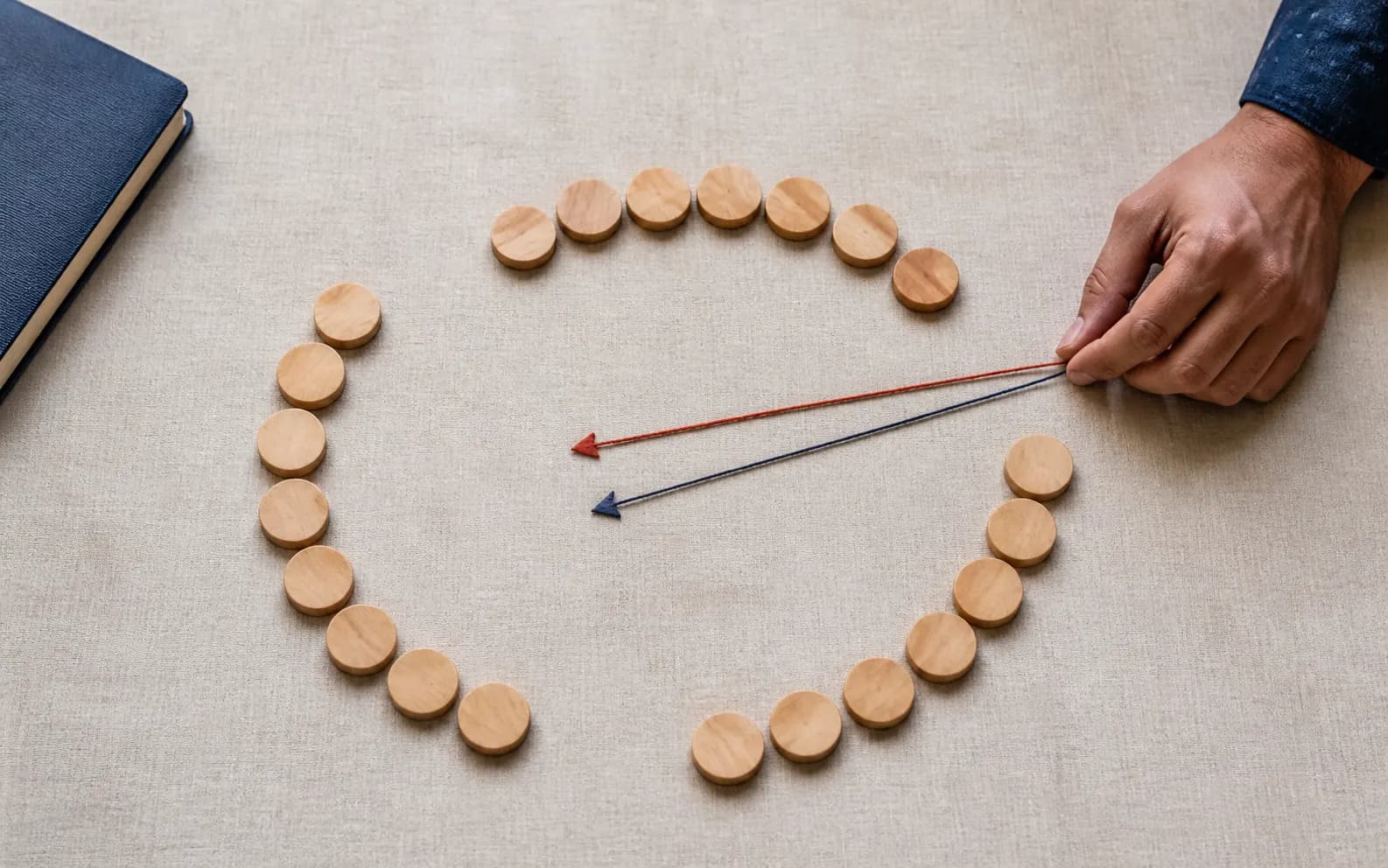
Tara koota is worth 3 of the thirty-six points, and five documented rule sets compute it differently enough that the same two birth stars can score full marks, half marks or nothing at all. For most couples it passes without comment. Then a second report arrives, the tara line reads differently from the first, and neither report explains how that is possible when the two birth stars have not changed.
Both reports can be right. Tara is one of the places in Ashtakoota where the tradition genuinely holds more than one rule, and the choice between them is almost never printed on the page that reports the score.
What is tara koota actually counting?
It counts whole nakshatras between two birth stars, divides that count by nine, and reads the remainder against a cycle of nine named taras. Tara means star. The distance is not measured in degrees and it does not care how far into a nakshatra either Moon sat — which is a mercy, because pinning the Moon’s exact degree depends on a birth time recorded to the minute, on the right entry in the IANA time zone database for the place of birth, and on an ephemeris good enough to place the Moon. Tara needs only the star name, so it survives imprecision that the other kootas do not.
Begin at one person’s nakshatra. Count forward around the circle of twenty-seven, including the star you started on, until you reach the other person’s. That count is the raw figure. Ashwini to Ashwini is one, not zero — the inclusive convention is universal here and it is the source of a good deal of confusion when people try to redo the arithmetic at home.
Then divide by nine and keep the remainder. Nine, because the taras run in a cycle of nine: Janma, Sampat, Vipat, Kshema, Pratyak, Sadhaka, Vadha, Mitra, Parama Mitra. The remainder tells you which of the nine the other person’s star falls on, with remainder zero standing for the ninth, Parama Mitra. Three of the nine — Vipat, Pratyak and Vadha, sitting at remainders three, five and seven — are the ones the tradition marks as adverse.
That is the whole mechanism, and every school we transcribe agrees on it. Twenty-six of the twenty-seven stars are involved in exactly the same way, there is no table to look up, and you can do it on your fingers. What the schools do not agree on is what to do with the answer once they have it. The tara koota calculator prints the count, the remainder and the tara name for both directions, so the arithmetic above can be checked against it rather than taken on trust.
Why do the two directions give different numbers?
Because counting is not symmetric on a circle: the count from the bride to the groom and the count from the groom to the bride always add up to twenty-nine. Twenty-seven stars, plus one for each end being counted inclusively. That identity holds for every pair of birth stars there is, and it is the single most useful fact in this entire subject.
Work an example. Ashwini is the first star and Purva Bhadrapada is the twenty-fifth. Counting forward from Ashwini you reach Purva Bhadrapada on the twenty-fifth step. Counting forward from Purva Bhadrapada you pass Uttara Bhadrapada, then Revati, then wrap to Ashwini — four steps. Twenty-five plus four is twenty-nine. Divide each by nine and the remainders are seven and four: Vadha in one direction, Kshema in the other.
One adverse reading and one favourable one, from the same two stars. Nothing has gone wrong. The koota is asymmetric by construction, and the only couples who get the same figure both ways are the ones who share a birth star, where both counts come out at one.
The two counts always sum to twenty-nine, so a couple who look adverse from one side can look favourable from the other, and which side you were shown was a decision somebody made before your report was printed.
Which of the five rules did your report use?
There are five documented ways to turn those two remainders into a score, and a report that prints only the score does not tell you which one it applied. Each one is attached to a named source. None of them is a mistake.
- Both directions, split evenly. The mainstream rule, following Kalyana Varma’s Saravali and most North Indian practice. Half the points ride on each direction, so the groom read from the bride is worth one and a half and the bride read from the groom is worth one and a half. This is the rule that produces the partial tara scores people find puzzling.
- Both directions, weighted two to one. The girl-to-boy count carries two points and the return count carries one. The asymmetry is a commercial convention rather than a classical one: it splits the difference between a text that requires both directions and a South Indian practice that checks only one. We reproduce it because a large share of Indian matching sites run on the software that uses it, and a reader deserves to see the number their own report would have produced.
- One direction, all or nothing. Associated with B. V. Raman’s Muhurtha and with several South Indian panchangas, of the kind the Positional Astronomy Centre publishes the national tables for. Either the count from the girl to the boy lands on an acceptable tara and the couple takes all three points, or it does not and they take none. Under this rule one and a half is not a score that exists.
- One direction, stated as positions rather than remainders. A separate source, and arithmetically the same rule as the one above. It lists the acceptable results as the second, fourth, sixth, eighth and ninth taras, where the other lists remainders two, four, six, eight and zero. Position nine and remainder zero are the same tara.
- Both directions, but only even remainders accepted. Equivalent to the mainstream rule with Janma tara moved into the adverse group. The one-line difference is the subject of the next section.
Two of the five turn out to be one rule written twice, which matters if you are counting how much disagreement there really is. We keep them as separate entries because the sources are separate and a reader tracing a citation should land on the book they were quoted, but anyone counting distinct outcomes should count four, not five. Being able to say that is one of the reasons the engine records which text each rule came from rather than only what it does.
What happens when the two of you share a birth star?
You get Janma tara in both directions, and the five rule sets split two against three on whether that is acceptable. Remainder one, the first of the nine, is what the count returns when it comes back to the star it began from.
This is not a theoretical edge case. Every couple born under the same nakshatra produces it, and given twenty-seven stars, a shared birth star is roughly a one-in-twenty-seven event in the population — uncommon, but not rare enough to ignore, and completely determined once you know both stars.
Under the two rules that accept Janma tara, such a couple takes the full 3 points. Under the three that do not, they take nothing. There is no middle outcome and no amount of care in the birth time changes it. The result is decided entirely by a choice the astrologer or the software made before either chart was drawn.
Raman’s own worked example rejects a couple on exactly this remainder, so the stricter reading is not an eccentricity. It is printed, sourced and defended. So is the other one. This is a place where the honest thing to say is that the tradition contains two answers, and the dishonest thing is to print one of them next to the word “correct”.
Can tara koota ever score zero?
Under the mainstream both-directions rule, no — a flat zero on tara is arithmetically impossible, and the measured rate across every pairing is 0%. That is not a small-sample result. It is a consequence of the twenty-nine identity, and it can be proved in two lines.
The two counts sum to twenty-nine. Twenty-nine leaves remainder two when divided by nine, so the two remainders must also sum to two, or to eleven, once the wrap is allowed for. Now try to make both of them adverse. The adverse remainders are three, five and seven. Three plus eight, five plus six, seven plus four — every adverse remainder is forced to pair with a favourable one. There is no combination of two adverse taras that satisfies the identity.
So under that rule a couple scores either the full three, when neither direction is adverse, or one and a half, when exactly one is. Nothing else. Full marks go to 33.3% of pairings and the mean award is 2 out of 3.
Those rates come from scoring every one of the 11,664 ordered nakshatra-pada pairings, not from a sample of couples, so there is no margin of error to attach to them. You can also get the full-marks figure without a computer: three adverse remainders out of nine gives a one-in-three chance that a given direction is adverse, the two directions cannot both be adverse, so a third of pairings clear both. The engine agrees with the hand calculation, which is the point of doing both. The base rate tables carry the same figures for the other seven kootas.
A single-direction rule behaves completely differently. There, one adverse count takes all three points, and roughly a third of pairings lose them. Same two stars, same arithmetic up to the last step, and a zero that one rule cannot produce and another produces routinely.
What does the rule choice do to a real pair of birth stars?
Run the sample couple published on this site through four of the five rules and the tara line reads one and a half, one, zero and one and a half. The bride’s star is Ashwini and the groom’s is Purva Bhadrapada, which is the pair worked through above: twenty-five one way, four the other, Vadha and Kshema.
Under the mainstream split, the adverse direction forfeits its half and the favourable one keeps it: one and a half out of three. Under the two-to-one weighting the adverse direction happens to be the one carrying two points, so only the single point survives. Under the single-direction rule the adverse count is the only count that is looked at, and the koota goes to zero. Under the even-remainders rule the result matches the mainstream one, because neither remainder here is one.
Three different tara scores from four rules, on two birth stars that anybody can count on their fingers. This is the smallest, cleanest demonstration in Ashtakoota that a matching score is a function of a rule choice and not only of two charts, and it needs no planetary positions at all — only two star names. Everything upstream of those names can be flawless, from the JPL planetary ephemerides down to the recorded minute of birth, and the divergence still happens. If you want to watch the same effect across all eight kootas at once, the guna milan calculator runs the full set side by side.
Does a three-point koota matter when the pass mark is eighteen?
It matters exactly when your total lands within three points of the line, and a large share of totals do. The average Ashtakoota total is 20.1 out of thirty-six and 66.7% of pairings clear the conventional eighteen.
The distribution is bunched. Move up two points from the pass mark and 49.5% still clear; move up again and 33.8% do. Totals crowd around the middle of the scale, which is precisely the region where a three-point koota decides an accept-or-reject verdict. A koota worth three points out of thirty-six sounds like something you can lose without consequence. If the total you were given sits at seventeen and the line you were held to is eighteen, it is not. Economists who studied how Indian families actually weigh match criteria found caste and horoscope filters treated as near-absolute rather than as one factor to be traded against others — Banerjee, Duflo, Ghatak and Lafortune measured that in the marriage-advertisement market. A threshold treated as absolute is a threshold where three points decide something.
There is a wider point here that is worth arguing with rather than accepting. The eighteen-point line is itself a convention, not a measurement, and treating a score of seventeen and a half as categorically different from eighteen gives the arithmetic a precision it never claimed to have. That argument belongs to the post on where eighteen came from, and it does not need tara to make it.
What should you ask the person who gave you the number?
Three questions, and anyone who has actually computed the score can answer all three in a sentence each. None of them is a challenge to their competence. They are questions about which of several documented conventions was applied.
- Which direction did you count? One way or both. If both, was the split even or weighted. If they counted one way only, ask what the other direction gives, because you now know it is twenty-nine minus the first.
- Was Janma tara treated as acceptable? This decides the entire koota if the two of you share a nakshatra, and is irrelevant otherwise. A one-word answer either way.
- Which source is the rule from? Saravali, Raman, a named panchanga, or the default in a piece of software. All four are real answers. The fourth is still an answer, and it is the one most often true.
You can also read the answer off the report without asking. One and a half points means a both-directions rule with an even split. One point means the weighted variant. Three or zero with nothing in between means a single-direction rule, and the reading you were not shown may differ. A report that never explains which family it belongs to has still told you, if you know where to look.
What does tara not tell you?
It does not tell you anything about two people. It tells you where two birth stars sit relative to each other on a circle of twenty-seven, and what a named tradition concludes about that spacing. The names of the nine taras are vivid — one of the adverse three translates as death — and that vividness is doing work that the arithmetic does not support.
Tara also ignores a great deal. It reads the nakshatra number and nothing else: not the pada, not the Moon’s exact degree, not a single planet. Two couples with identical tara results can have nothing else in common. The other seven kootas, which are described one by one in the walk through all eight, read different columns of the same table and reach different conclusions from them.
And it is a North Indian construct. The South Indian systems compute a related but distinct thing under the name dina porutham, with its own list of acceptable results and its own severity. A Chennai astrologer and a Delhi astrologer looking at the same two birth stars are not applying a dialect of one rule; they are applying two rules with a common ancestor. That gap is the subject of the comparison of the two systems, and it is wider than most families are told.
What we will say is which rule produces which result, where each rule is written down, and how often that result occurs. What none of it establishes is anything about a marriage.
Questions people ask
How many points is tara koota worth?
Three of the thirty-six in Ashtakoota. It is the third-smallest koota, ahead of varna and vashya and well behind nadi and bhakoot. The size is misleading, though, because the conventional accept line sits at eighteen and a three-point swing crosses it from either side.
Which taras are the bad ones?
Vipat, Pratyak and Vadha — the third, fifth and seventh of the nine. They correspond to remainders three, five and seven when the nakshatra count is divided by nine. The other six remainders, including zero, are treated as favourable by every rule set we transcribe.
What is Janma tara and why is it disputed?
Janma tara is remainder one, which is what you get when the count comes back to the star it started from. Two of the five documented rule sets treat it as acceptable and three treat it as inauspicious. Any couple sharing a birth star lands on it in both directions, so this single choice decides their whole tara score.
Does tara koota use the pada as well as the nakshatra?
No. Tara reads the nakshatra number only, so all four padas of a star behave identically. The pada matters for the Moon sign, which drives varna, vashya, graha maitri and bhakoot, but tara is indifferent to it.
Is a low tara score a reason to refuse a match?
We do not say what is or is not a reason to refuse anything. What we can say is which rule sets produce which tara result on two given birth stars, where each rule is written down, and how often that result occurs across every possible pairing. What a family does with that is theirs to decide.
Sources
Claim-level links appear in the article; URL-derived IDs keep each full reference identifiable if this list is reordered.
- DR-1GAR9X7 Kalyana Varma, Saravali — scanned editions — Internet Archive, various printings
- DR-1U6XF3T B. V. Raman, Muhurtha — scanned editions — Internet Archive, various printings
- DR-DDY8TY Rashtriya Panchang and Indian Astronomical Ephemeris — Positional Astronomy Centre, India Meteorological Department, 2025
- DR-30WG0O Planetary and Lunar Ephemerides DE440 and DE441 — NASA Jet Propulsion Laboratory, Solar System Dynamics, 2021
- DR-AXILXB JPL Horizons System — NASA Jet Propulsion Laboratory, 2025
- DR-9AH1WP Time Zone Database — Internet Assigned Numbers Authority, 2025
- DR-1F6U0ET Marry for What? Caste and Mate Selection in Modern India — American Economic Journal: Microeconomics, 2013
Use the evidence
Check it on your own chart
These tools apply the same named rules described above. They are free, require no sign-up, and store nothing.