The score itself · Evidence-led explainer
Yoni koota and the 7.3% full-marks rate
Only 7.3% of pairings score full marks in this koota. Here is the measured rate and both matrices in use.
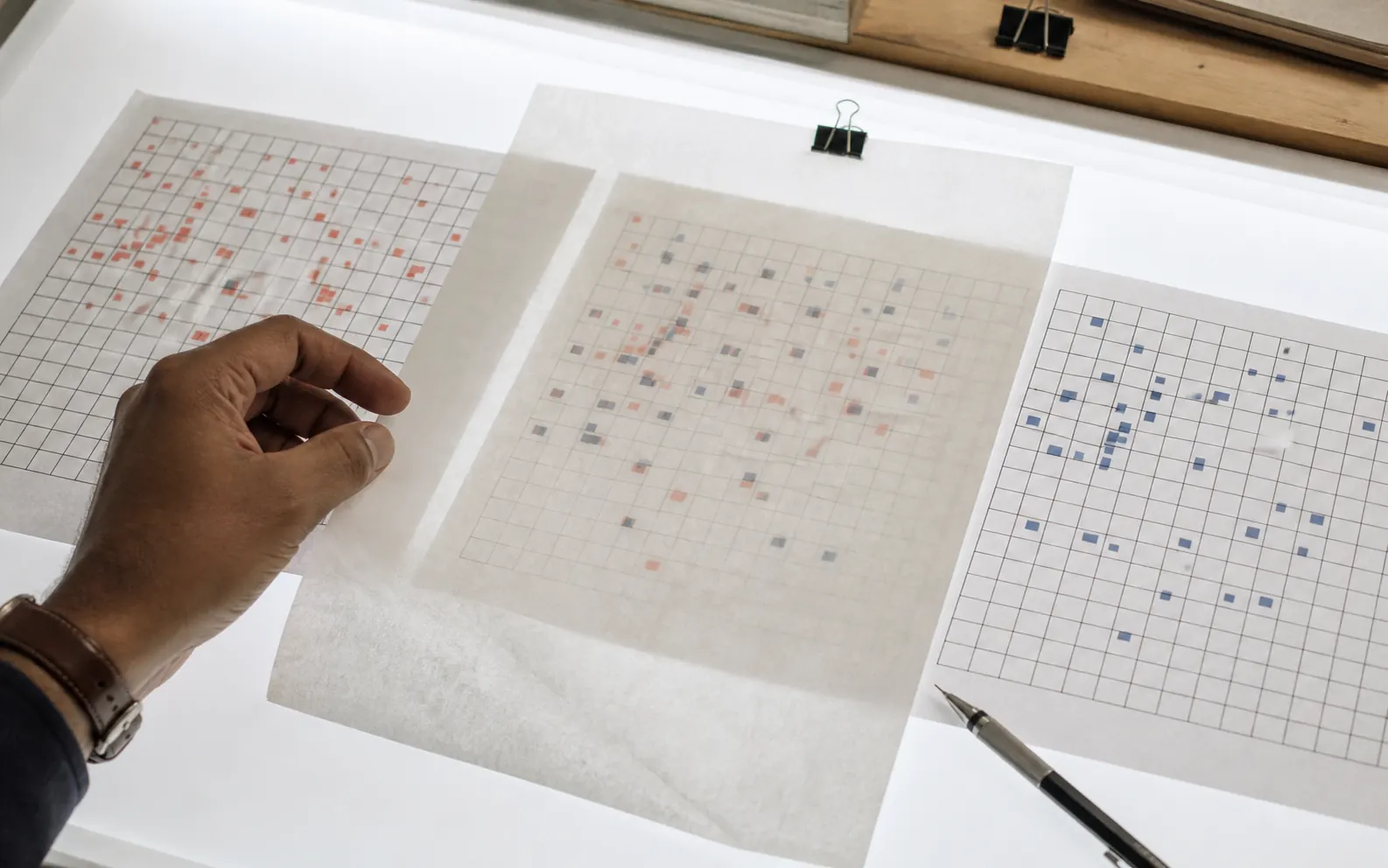
Full marks on yoni need the same animal on both sides, so they are uncommon among possible pairings. Yoni is worth 4 points of the thirty-six and it is the koota people ask about most. Here is the number that reframes it: across all 11,664 possible pairings of birth star and pada, only 7.3% score full marks.
A partial Yoni score is a table result, and it is the common case in this enumeration. It describes the selected animal pairing under a named matrix; it does not establish a couple’s sexual or relationship compatibility. We have not measured scores in a cohort of long-married couples. The average across the equally weighted possible pairings is 1.9 of four, which is another way of saying that the middle of the range is where this koota lives.
Why do so few possible pairings score full marks?
Because the diagonal of a fourteen-by-fourteen table is a small place. Each of the twenty-seven nakshatras carries an animal symbol — horse, elephant, sheep, serpent, dog, cat, rat, cow, buffalo, tiger, deer, monkey, mongoose, lion. Fourteen animals, twenty-seven stars, so most animals are shared by two stars apiece. Yoni scores the pair of animals, never the pair of stars.
How to read the reference below: the twenty-seven stars are grouped under fourteen animal symbols. Most symbols contain two stars; mongoose contains one. This grouping is the lookup behind the score, not a description of either person.
| Animal | Stars |
|---|---|
| Horse | Ashwini (m), Shatabhisha (f) |
| Elephant | Bharani (m), Revati (f) |
| Sheep | Krittika (f), Pushya (m) |
| Serpent | Rohini (m), Mrigashira (f) |
| Dog | Ardra (f), Mula (m) |
| Cat | Punarvasu (f), Ashlesha (m) |
| Rat | Magha (m), Purva Phalguni (f) |
| Cow | Uttara Phalguni (m), Uttara Bhadrapada (f) |
| Buffalo | Hasta (f), Swati (m) |
| Tiger | Chitra (f), Vishakha (m) |
| Deer | Anuradha (f), Jyeshtha (m) |
| Monkey | Purva Ashadha (m), Shravana (f) |
| Lion | Dhanishta (f), Purva Bhadrapada (m) |
| Mongoose (unpaired) | Uttara Ashadha (m) |
The maximum is awarded on the diagonal only: both parties must carry the same animal. Thirteen of the fourteen animals are held by exactly two stars; the mongoose is held by one, Uttara Ashadha, and stands alone. Count the star pairs that put two of the same animal together and you get fifty-three of the seven hundred and twenty-nine possible star combinations. That fraction is the measured rate, arrived at from the other direction.
The rarity is a property of the table, not a comment on any couple.
This is a genuinely useful thing to know, because it converts an emotional number into an arithmetical one. Nobody scores full marks on yoni for a reason that has anything to do with them. They score full marks when a lottery over twenty-seven stars happens to land two people on the same one of fourteen symbols, and it usually does not. The nakshatra finder will tell you which animal a birth star carries in a couple of seconds.
What is the animal actually attached to?
To the birth star, which is a segment of the Moon’s path and nothing more. The twenty-seven nakshatras divide the ecliptic into equal arcs of thirteen degrees and twenty minutes each. Whichever arc the Moon occupied at the moment of birth is the birth star, and every attribute the matching system reads — the animal, the gana, the nadi, the rajju — is a property of that arc rather than of the person born under it.
The lunar mansion scheme is old and well documented as a scheme; the standard encyclopaedia entry on lunar mansions in Indian astronomy traces its development, and Pingree’s work on the transmission of astronomical material into and out of India gives a sense of how much of the surrounding doctrine travelled. What the historical record does not contain is any derivation of the animal assignments themselves. They are given, not argued for, in every source that carries them.
That matters for how much weight the assignment can bear. A rule with an unbroken chain of citation behind it is still a rule somebody wrote down once. Our engine cites the text each rule comes from precisely so this stays visible — a reader can see that the animal for Ashwini rests on a table in a named printed source, and can decide for themselves what that is worth.
If you want the full list of stars and their attributes side by side, the nakshatra guide lays them out. What it will not do is explain why a horse is a horse.
Which pairings score nothing, and how many are there?
Seven animal pairs are held to be sworn enemies, and they carry a zero in every matrix. Cow and tiger. Elephant and lion. Horse and buffalo. Dog and deer. Serpent and mongoose. Monkey and sheep. Cat and rat. Seven pairs out of the ninety-one possible combinations, and this is one of the few places in the whole subject where the sources are unanimous.
The share of all pairings landing on one of those cells is 7.1%. Set that against the full-marks share and something becomes clear: the two extremes are almost exactly the same size. The rare good outcome and the rare bad outcome are equally rare, for the same structural reason, and everything real happens between them.
The small gap between the two rates is not noise, and it has a cause worth a sentence. Six of the seven enemy pairs join two animals that each hold two stars, which gives eight ordered star combinations apiece. The seventh — serpent and mongoose — involves the mongoose, which holds only one star, so it contributes half as many. That single missing star is the entire difference between the zero rate and the full-marks rate.
Someone born under Ashwini therefore carries a horse, and the pairings that score nothing for them are the two buffalo stars, Hasta and Swati. Not a class of person. Two stars out of twenty-seven, fixed in a table, the same for everyone born in that arc.
One structural fact about the zero deserves more attention than it gets: there is nothing attached to it. Nadi and bhakoot each carry a named dosha and a long registry of conditions under which named sources hold the dosha should be set aside. Yoni carries neither. No classical text declares a yoni dosha, and no source we have been able to trace offers a cancellation for one. The four points are simply not awarded, and the calculation moves on to the next koota.
That asymmetry is worth holding on to when a yoni zero is presented as a serious obstacle. A tradition that considered a finding grave tends to leave behind centuries of argument about how to relieve it, as nadi plainly did. The silence around yoni is evidence of how the tradition itself weighted the thing.
What sits between full marks and zero?
Most possible pairings, distributed across three intermediate values. The traditional matrices grade each animal pair on a scale, and the graded cells are the great bulk of the table. In the South Indian matrix, forty-three of the ninety-one animal pairs sit at the middle value, fifteen sit one step above it and twenty-six one step below.
Read as a distribution rather than as a verdict, that shape is the whole story of the koota. Yoni was built as a graded quantity. Treating a two or a three as a rejection reads the table against its own design, and does so in a way the design makes easy, because the number is small and the maximum is visible next to it.
There is an argument, and it is not a silly one, that scoring out of four rather than grading in words was the mistake. A grade of “middling” invites a shrug. A two out of four invites a calculation. The South Indian porutham systems kept the grades and the North Indian Ashtakoota converted them into points, and a good deal of the anxiety attached to this koota arrived with the conversion. That is an opinion, but it is one the two systems’ own vocabulary supports.
The yoni koota tool shows the cell your two stars land in along with the rest of the row, which is a faster way to see the grading than any description of it.
Which of the two matrices did your report use?
This is the question almost no report answers, and it is worth more than the score. Two complete yoni matrices are in circulation. One descends from the South Indian printed lineage, reproduced in Raman’s Muhurtha and repeated in several later compilations. The other comes from the North Indian lineage and is a genuinely different table rather than a variant transcription.
They agree on the diagonal and they agree on the seven enemy cells. We compared them cell by cell across the whole grid, and they disagree on thirty-five of the ninety-one animal pairings — well over a third of the table. Because those thirty-five include several of the commonest animal combinations, the choice of matrix changes the yoni score for more than a third of equally weighted possible pairings.
The disagreement also has a direction, which is rarely mentioned. The North Indian table is systematically the more generous of the two: it holds twenty-three pairs at the highest graded value against fifteen in the South Indian table, and only sixteen at the lowest against twenty-six. Two calculators, both entirely traditional, will not disagree randomly about your yoni. One of them will tend to be kinder.
On a koota worth 4 points that is a swing of one or two points on a great many charts, and it feeds directly into the broader finding that 56.4% of enumerated pairings trigger a tested difference or veto. That aggregate combines several checks; it does not isolate the effect of changing the Yoni matrix.
What are the printing errors in the older table?
Two cells break the symmetry the koota requires, and only one of them was known. A yoni matrix has to be symmetric. The value for a horse paired with a deer must equal the value for a deer paired with a horse, because this koota scores a pair and not a direction. The older printed table is not symmetric in two places.
The first is horse against deer, where the two halves of the table disagree by two points. That one is already flagged in the reference literature, alongside a remark that every other cell in the matrix is symmetric. The remark is not true. There is a second asymmetry, buffalo against lion, and it is unflagged anywhere we have been able to find.
It surfaced here for an unglamorous reason: the table is checked cell by cell when the code loads, and a check that runs across all one hundred and ninety-six cells does not lose concentration at cell one hundred and forty. Both cells are resolved the same way — against the North Indian table, which is independently sourced and symmetric as printed.
The uncorrected table is kept as well, because several widely used open-source implementations reproduce that printed source verbatim and inherit both faults. Reproducing their output requires reproducing their table. Which version produced a given line is recorded on the result rather than left to be worked out from the total.
Does the male or female classification change the score?
In most traditions it does not touch the points at all. Each animal is additionally classed as male or female — fourteen of the twenty-seven stars male, thirteen female — and three positions are documented on what to do with that.
The commonest ignores it entirely and scores the animals alone. A second uses it qualitatively, labelling the combination best, middling or worst without altering a single point. A third, regional, applies a numeric penalty in exactly one configuration: the groom’s star female and the bride’s male.
That third position is marked low confidence in our reference document, and the reasons are stated rather than implied. The source reports it second-hand. Its own author writes that the terminology is not clear. No classical text gives a numeric penalty at all. It remains available because one regional tradition is recorded as using it, and it is never applied without being named, because a deduction resting on a second-hand sentence should not arrive silently inside a total.
If a report has docked you points on this basis without saying so, the score you were shown is not the score the majority of traditions would have produced, and the difference is not small on a four-point koota.
What does yoni look like for the sample couple?
Priya and Arjun land in a cell all three tables agree on, which is its own kind of useful. Her birth star is Ashwini, which carries the horse. His is Purva Bhadrapada, which carries the lion. Horse against lion sits low on the scale, and it sits at the same low value in the South Indian table, in the North Indian table and in the uncorrected printed version.
So on this axis there is nothing to argue about. Their yoni score is one of four, and no choice of matrix, no correction of a printing error and no position on the male-female question would move it. That is worth saying plainly, because a page arguing that tables disagree has an obvious temptation to pick an example where they do.
Both their stars are also classed male, which under the qualitative reading produces the least favourable of the three labels and under the regional numeric reading produces no penalty at all — the penalty fires only when the groom’s star is female and the bride’s male. A reader following along on the guna milan tool can watch all of this happen with the variant printed beside each line.
Where their charts do diverge is elsewhere, and severely: the five traditions we compare return totals from thirteen and a half to seventeen on the same two charts, and the two lowest scores are the two that accept. Yoni is not the reason. It rarely is.
How much can a yoni disagreement move a total?
One or two points, which is enough to matter only where the distribution is densest. The conventional accept line is eighteen of thirty-six and 66.7% of pairings reach it. The mean total is 20.1, so the line sits just below the middle of the pile.
A two-point matrix disagreement therefore does its work in exactly the region where the most couples are. For a chart at sixteen or seventeen, the difference between the South Indian and North Indian yoni tables can be the difference between a refusal and an acceptance, decided by which printed lineage a piece of software was built from.
What it cannot do is rescue or sink a chart from a distance. At twenty-four or above — where 33.8% of pairings sit — the yoni question is academic. At twelve it is equally academic in the other direction. The koota-by-koota breakdown is the fastest way to see where your own total actually came from.
This is also why yoni and gana get confused so often in conversation. Both attach a category to a birth star, both sound like statements about temperament, and only one of them carries a formal dosha. The gana page takes that one on directly.
What should you ask about a yoni score?
Three questions, and any of them may change the number you were given. Which matrix — the South Indian lineage or the North Indian. Whether the printed asymmetries were corrected. And whether the male-female penalty was applied, given that most traditions do not apply it.
There is a fourth question that is not about yoni but decides it: what was the birth time, and how was it converted. The birth star comes from the Moon’s longitude, which comes from an ephemeris and a timezone. Ours reads JPL’s DE440 series for positions and the IANA time zone database for the historical offsets, because India has not always kept the offset it keeps now. The Moon crosses a star boundary roughly once a day. A remembered birth time can move an animal.
If your reading returned a partial yoni score and nothing else was flagged, the honest answer is that these questions may change nothing at all. Most pairings score partial on yoni, the average total lands where it lands, and a two out of four is what the table was built to produce.
The point of asking is narrower than winning an argument. It is to establish whether the number in front of you is a fact about two charts or a fact about a table somebody happened to have. Those are different kinds of statement, and only one of them deserves to be treated as settled.
Questions people ask
We only scored two out of four on yoni. Is that bad?
It is the ordinary outcome. Full marks are awarded only when both birth stars carry the same animal symbol, and there are fourteen animals spread across twenty-seven stars, so a partial score is what the structure of the table produces for the majority of equally weighted possible pairings. Two out of four is close to the average result.
What are the sworn-enemy pairs in yoni?
Seven animal pairs score nothing in every published matrix: cow and tiger, elephant and lion, horse and buffalo, dog and deer, serpent and mongoose, monkey and sheep, cat and rat. They are unanimous across the sources, which is unusual in this subject and worth noting.
Is one published yoni matrix more authoritative than the other?
Neither is a method-free default: they belong to two documented regional lineages. The North Indian table is independently sourced and symmetric as printed, while the older South Indian printed table contains two asymmetric cells that require an explicit correction choice. A checkable report should name the lineage and table version it used rather than call either one universal.
Is a yoni zero the same thing as a dosha?
No. Yoni has no dosha attached to it in the way nadi and bhakoot do, and no cancellation registry of its own. A zero simply means the two animals sit in one of the seven enemy cells, and the four points are not awarded. Nothing further is triggered.
Can the yoni animal change if our birth time is slightly wrong?
Yes. The animal is attached to the birth star, and the Moon moves through a star in roughly a day, so a birth time recorded from memory rather than a record can land on the wrong side of a boundary. A report should tell you when a finding sits close to one.
Sources
Claim-level links appear in the article; URL-derived IDs keep each full reference identifiable if this list is reordered.
- DR-1AAO7WB B. V. Raman, Muhurtha (Electional Astrology) — the South Indian yoni matrix as printed — Raman Publications, scanned by the Internet Archive, 1948
- DR-HAEXD3 Kalyana Varma, Saravali — the yoni assignments in the classical lineage — Internet Archive scan, 2017
- DR-1F1F7DE Brihat Parashara Hora Shastra — the parent text for the nakshatra attributes — Internet Archive scan, 2017
- DR-UN9U8V S. R. Sarma, “Lunar Mansions in Indian Astronomy” — Encyclopaedia of the History of Science, Technology, and Medicine in Non-Western Cultures, Springer, 2008
- DR-12UQSIX David Pingree, “The Recovery of Early Greek Astronomy from India” — Journal for the History of Astronomy, 1976
- DR-30WG0O JPL DE440 planetary and lunar ephemerides — the Moon longitudes the birth star is read from — NASA Jet Propulsion Laboratory, Solar System Dynamics, 2021
- DR-9AH1WP IANA Time Zone Database — the historical offsets a birth moment has to be converted through — Internet Assigned Numbers Authority, 2026
Use the evidence
Check it on your own chart
These tools apply the same named rules described above. They are free, require no sign-up, and store nothing.