The doshas · Evidence-led explainer
Sade Sati: seven and a half years of what, exactly?
Understand the three Sade Sati phases as Saturn crosses the signs before, of and after your natal Moon—and the limits of what this transit can predict.
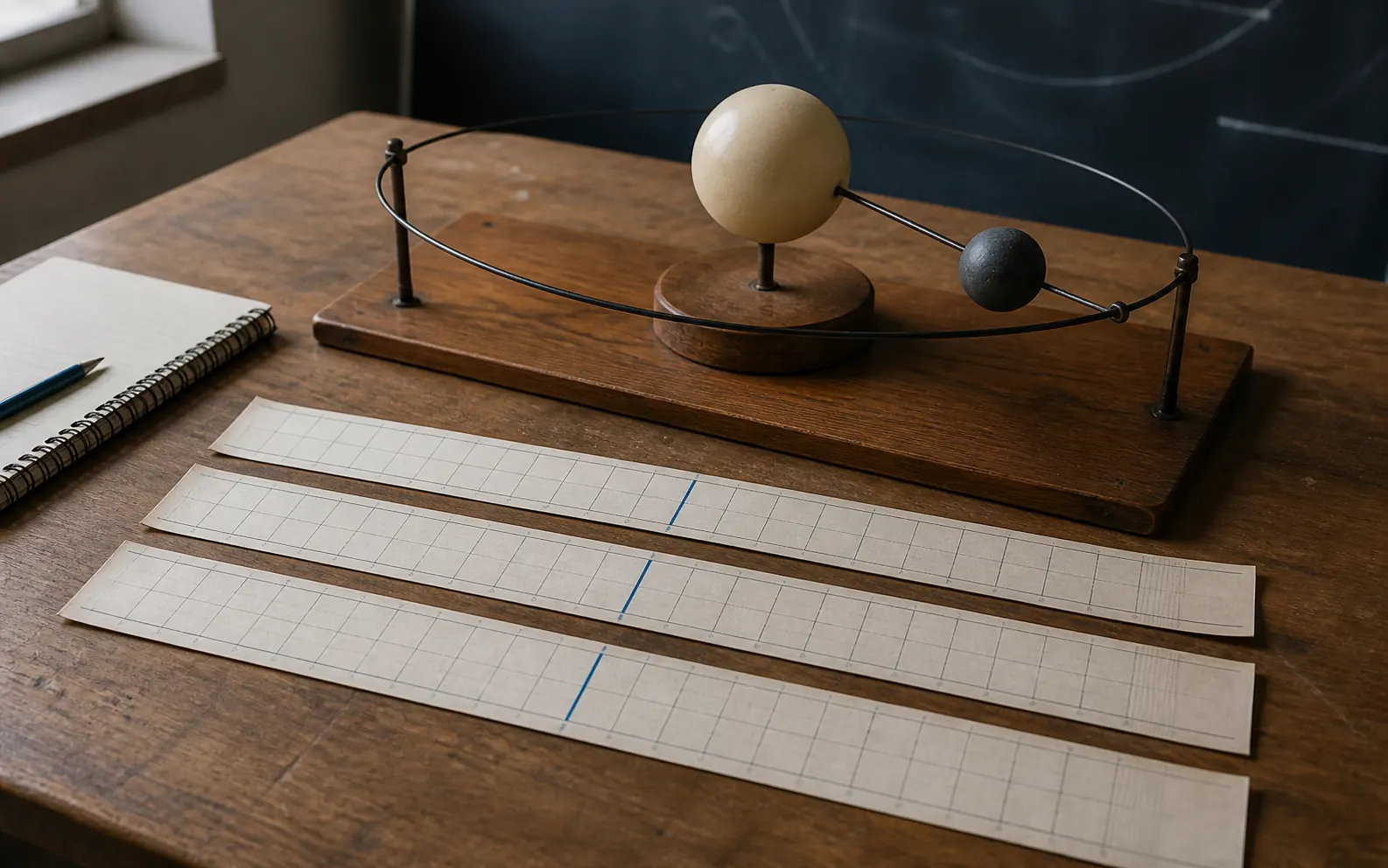
Sade sati is the period during which transiting Saturn crosses the three rashis centred on the one your Moon occupied at birth, and its length is arithmetic rather than doctrine. The phrase names its own duration — seven and a half. What it does not name is what those years are supposed to contain, and that gap is where most of the fear lives. So it is useful to be precise about what the term describes, which is an astronomical arrangement, and to separate that cleanly from what various traditions have concluded about it.
What exactly is the arrangement being described?
Saturn passing through the twelfth, first and second rashis counted from the natal Moon — three consecutive signs, entered and left on a schedule fixed by an orbit. There is nothing else in the definition.
Saturn takes a little under thirty years to complete one circuit of the zodiac. Divide that circuit by twelve rashis and it spends something close to two and a half years in each. It is the slowest of the classical grahas by a wide margin, which is why it is the one discussed in terms of eras rather than moods, and why its transits get names when Mercury’s do not. The orbital elements are not a matter of tradition; JPL publishes Keplerian elements for Saturn that anyone can integrate for themselves.
Find the rashi the natal Moon sits in. Sade sati begins when Saturn enters the rashi before that one, continues through the rashi itself, and ends when Saturn leaves the rashi after it. Three rashis, at roughly two and a half years each. Seven and a half years. The name is the sum.
Practitioners divide the window into three phases, one per rashi: the rising phase while Saturn is in the twelfth from the natal Moon, the peak while it is over the Moon itself, and the setting phase in the second. That division is worth understanding because it is arithmetic, not interpretation. Schools that disagree sharply about what the phases mean do not disagree about where the phase boundaries fall. The sade sati calculator shows the current status and phase. It does not compute start and end dates for all three phases.
Why is this a transit rather than something in your chart?
Because nothing about it is recorded at birth; it describes where Saturn happens to be right now, relative to where the Moon was then. This is the part that most often goes unsaid, and it changes how the whole thing should be heard.
Saturn keeps moving. Every person alive enters sade sati, sits in it for seven and a half years, and leaves it — and then, roughly two decades later, enters it again. Most people who live a normal span go through it two or three times. A birth chart does not contain sade sati any more than a passport contains the weather.
A person is not sade sati the way a person might be manglik; they are in it, the way one is in a monsoon.
Three rashis out of twelve is a quarter of the sign categories. For a given Saturn sign, three possible natal Moon signs put a chart inside the window. That yields one quarter only when those signs are weighted equally. It is not a survey of people, a measurement of the candidates a family is considering, or proof that exactly one quarter of a lifetime is spent in the transit. Actual time in each sign varies, and retrograde crossings complicate the dates. Neither the category count nor the duration establishes a marriage prediction.
There is a second thing that follows from it being a transit, and it is the practical one. A chart feature is permanent; a transit has an end date. Whatever a tradition concludes about the period, the arithmetic that fixes its end is the same arithmetic that fixed its beginning, and it can be computed years in advance.
Which reference point decides the window, and what happens when it is disputed?
Everything hangs on one number — the rashi of the natal Moon — and near a rashi boundary that number is decided by a choice rather than a measurement. The choice is the ayanamsa: the offset applied between the tropical and sidereal zodiacs.
Different schools use different ayanamsa values, and they differ by more than a degree. A Moon sitting near the end of a rashi under one value sits at the start of the next under another. When that happens the entire sade sati window shifts by about two and a half years, and two competent astrologers using the same ephemeris will hand a family two windows that barely overlap. Neither has made an error. They have made different disclosed choices, or more often, different undisclosed ones. That mechanism is set out in full in the ayanamsa explainer, so it will not be re-derived here.
Reference points are the largest single source of disagreement we have found anywhere in this subject, and the manglik axis is where we have been able to measure it directly. Holding the houses fixed and changing only the point Mars is judged from — ascendant, or Moon, or Venus — moves the share of charts flagged by 29 percentage points, against about 3 for the house-list argument everyone actually has. Sade sati has exactly one reference point, and it is a Moon whose rashi can be argued about at the edges.
If the natal Moon falls within a degree or so of a rashi boundary, the ayanamsa question is live and the whole seven-and-a-half-year window is disputable. If it falls in the middle of a rashi, every mainstream ayanamsa agrees and the window is identical under all of them. Which of those two situations applies is a single number on the chart, and it is worth establishing before anyone plans around dates.
Why those three rashis, and why counted from the Moon rather than the ascendant?
Because the convention reads the transit against the Moon as the significator of mind and sustenance, and takes the rashi before and after as the approach and the departure. Both halves of that are conventions, and both are occasionally disputed, which is more than most reports admit.
Counted from the natal Moon, the twelfth is traditionally associated with expenditure and loss, the first with the self, and the second with family and accumulated resources. Saturn arriving in the twelfth is read as the approach; sitting on the Moon itself as the closest pass; moving into the second as the departure with consequences still settling. Whether one accepts the associations or not, the three-rashi window is not arbitrary within the scheme — it is the rashi itself plus one on each side, which is the smallest neighbourhood you can define around a point.
The reference point is the more interesting choice. Vedic practice uses several reference points for different purposes: the ascendant for matters of body and circumstance, the Moon for matters of mind, Venus in some marriage-specific readings. Sade sati is conventionally read from the Moon, and that convention is close to universal — but some practitioners also read Saturn’s transit from the ascendant alongside it, and a few weight the two together. When they do, a person can be described as inside a difficult Saturn period on one reference point and outside it on the other, from the same chart and the same ephemeris.
This is precisely the axis that turns out to matter most wherever it can be measured. On the manglik question, which is the one place we have a large enough sample to attribute the variance properly, the reference point is roughly ten times more consequential than the house-list argument that occupies most of the public discussion. Sade sati is more settled than manglik because the Moon convention is so widely shared. But “widely shared” is not the same as “stated”, and a report that does not name its reference point has left a reader unable to tell which of the two situations they are in.
One further convention deserves naming because families run into it. Some traditions count the phases by Saturn’s rashi ingress, as described above; others adjust the boundaries using the natal Moon’s exact degree, so that the peak phase is centred on the Moon rather than aligned to the rashi. The second method produces phase boundaries that can sit many months away from the first. Neither is a mistake. They are two conventions, and a set of dates without a stated convention behind it is a set of dates that cannot be reconciled with anyone else’s.
Why are the printed start and end dates softer than they look?
Because Saturn appears to reverse direction for several months of every year, so a boundary crossing is frequently not a single event. A report prints one start date. The sky often supplies three.
Retrograde motion is an appearance rather than a physical reversal. Earth moves faster on a shorter orbit, and when it overtakes Saturn on the inside, Saturn appears from here to slow, stop, drift backwards for some months, stop again and resume. Near a rashi boundary the consequence is concrete: Saturn can enter the new rashi, turn back into the old one, and enter again months later. The phase has begun, un-begun and begun again. A single printed date has quietly chosen one of those crossings and discarded the others, usually without saying which convention it followed.
Positional accuracy, by contrast, is the part that can be stated with a number. Checked against the JPL planetary and lunar ephemerides over two centuries of dates, the largest positional error this engine produces for any body is 0.44 arcseconds. Saturn moves slowly enough that an error of that size corresponds to well under a day at a rashi boundary. A reader who wants to check a single crossing without taking our word for it can query JPL’s Horizons service for Saturn’s longitude on the date in question.
One more thing corrodes a printed date, and it is not astronomical. The natal Moon’s longitude depends on the birth time, and the birth time depends on the local civil offset actually in force at that place on that day. India’s offsets have a documented history, recorded in the IANA time zone database. Get that wrong and the Moon moves; the Moon travels through a rashi in roughly two and a half days, so an offset error is only fatal for a Moon already near a boundary. Our positions tool states the offset it applied alongside the longitudes, so the two can be checked against each other.
What are the dhaiyas, and why do they get reported as sade sati?
They are two separate Saturn transits — the fourth and the eighth from the natal Moon — each lasting about two and a half years, and families frequently relay them under the sade sati heading because the news arrives in one conversation. Kantaka or Ardha Ashtama Shani for the fourth, Ashtama Shani for the eighth.
They are not phases of sade sati and they do not adjoin it. Counted from the natal Moon, sade sati occupies the twelfth, first and second; the dhaiyas sit at the fourth and the eighth, with untouched rashis on either side. A person can be in a dhaiya having left sade sati years earlier, and the two do not overlap.
The confusion is worth naming because it produces a specific misunderstanding. Somebody is told “Saturn is difficult for them right now”, hears “sade sati”, and then reads a seven-and-a-half-year duration onto a transit that runs for about a third of that. A report that gives dates should say which transit the dates belong to. If it does not, that is the first question, and it is answerable in one line.
The same care applies to the dasha periods that often appear on the same page. Vimshottari dasha is a wholly different scheme — a division of a nominal lifespan fixed at birth from the Moon’s nakshatra, not a transit at all. A Saturn dasha and a Saturn transit are two unrelated things that share a planet’s name, and the dasha calculator is where that scheme is laid out properly.
What do the traditions actually conclude about the period?
Classical and popular sources associate the window with difficulty, delay, obligation and a general slowing of affairs — and they disagree with each other about the details. Reporting that disagreement accurately is more useful than smoothing it into a single verdict.
Some readings hold the peak phase to be the hardest; others give that to the setting phase, on the reasoning that the second house concerns family and resources. Several traditions hold that a strong natal Saturn changes the reading substantially, so that the same transit is read differently for two people whose Moons sit in the same rashi. The electional literature — Raman’s Muhurtha is the accessible English example — treats Saturn’s position as one input among several when choosing a date, rather than as a veto.
Several traditions also prescribe observances for the period: recitations, fasting on a particular weekday, particular charitable acts. We report that these are prescribed, and by whom, and we make no claim about what any of them accomplishes. That restraint is deliberate and it is stated as a promise rather than left implied — the things we refuse to claim are written down so a reader can hold us to them.
What we will not do is tell a particular person what their seven and a half years will hold. We can compute where Saturn is, where the natal Moon is, which phase that produces, how many retrograde crossings fall on each boundary, and how sensitive the whole window is to the ayanamsa choice. Everything past that is a conclusion a tradition draws, and it is reported here as that tradition’s conclusion rather than as a fact about a person.
What does sade sati have to do with a marriage refusal at all?
Nothing, inside the matching system itself — it is not one of the eight kootas and contributes no points to the thirty-six. When it appears in a refusal it has been imported from outside the matching calculation, and it deserves to be examined separately from the score.
That separation matters because the two kinds of finding fail in different ways. Matching verdicts diverge because named traditions genuinely read the same two charts differently; we ran every documented tradition we implement over the whole population of possible pairings and 56.4% trigger at least one tested difference or veto across the combined census checks. Sade sati does not diverge that way. The schools agree on the geometry almost entirely, and what they disagree about is the reading and, at the edges, the ayanamsa.
There is also a marriage-market fact sitting underneath the astrology that the astrology tends to obscure. Indian arranged-marriage matching has been studied empirically — Banerjee, Duflo, Ghatak and Lafortune’s study of matrimonial advertisements is the best-known example — and the picture it gives is of families optimising over many attributes at once under time pressure. A transit classification can distinguish candidates with different Moon signs, but its frequency does not establish that it predicts relationship outcomes. The three-of-twelve calculation assumes equal weighting of signs and is not a survey of candidates. If a family uses it as a reason to wait, that choice should be stated separately from the matching score.
What should you check on the report you already have?
Four things, in order, and each of them is answerable from the report itself or from one question to whoever produced it. None of them requires you to argue about doctrine.
Which rashi is the natal Moon placed in, and how many degrees into it? That single number tells you whether the ayanamsa dispute touches your case at all. A Moon in the middle of a rashi is not in dispute; a Moon two degrees from a boundary is.
Which ayanamsa did the report use? This should be stated on any report and frequently is not. It is not an aggressive question and it has a one-word answer.
Are the dates for sade sati proper, or for one of the two dhaiyas? The durations are different by a factor of three, and the two get conflated more often than any other pair of findings in this area.
And, if a start or end date is being planned around: does that date sit near a retrograde crossing? If Saturn crosses the boundary three times, the report has picked one, and knowing which one it picked is the difference between a date and a date with a reason. If a marriage is being delayed over this, that last question is the one that turns an indefinite wait into a finite one.
Questions people ask
Does everyone get sade sati?
Saturn passes every natal Moon sign during its roughly thirty-year circuit, so the transit recurs for a person who lives through that cycle. Three of twelve natal Moon signs are included for any Saturn sign. That is a structural fraction, not a measured share of any group of people.
Why do two reports give different sade sati dates?
Almost always because they used different ayanamsa values, which moves every sidereal longitude including the natal Moon. If the Moon sits near a rashi boundary, one ayanamsa places it in one rashi and another places it in the next, and the entire window shifts by about two and a half years. Retrograde crossings account for most of the smaller differences.
Can sade sati be cancelled or remedied?
Several traditions prescribe observances for the period — recitations, fasting on a particular weekday, specific charitable acts. We can report that these are prescribed and by whom, and we do not make claims about what any of them accomplishes. The transit itself is an orbital fact and ends on a date that can be computed in advance.
Should a marriage be delayed until sade sati ends?
That decision belongs to the couple and, if they wish, advisers they trust. A calculation can identify the current transit under a named convention, but does not establish what delaying a marriage would achieve. Our tool reports current status, not a complete schedule of future boundary crossings.
Sources
Claim-level links appear in the article; URL-derived IDs keep each full reference identifiable if this list is reordered.
- DR-IZXVV5 Approximate Positions of the Planets — Keplerian elements for Saturn — NASA Jet Propulsion Laboratory, Solar System Dynamics
- DR-30WG0O JPL Planetary and Lunar Ephemerides (DE440 / DE441) — NASA Jet Propulsion Laboratory, Solar System Dynamics, 2021
- DR-AXILXB JPL Horizons System — on-demand ephemerides for solar system bodies — NASA Jet Propulsion Laboratory, Solar System Dynamics, 2026
- DR-9AH1WP IANA Time Zone Database — historical local time offsets by location — Internet Assigned Numbers Authority, 2026
- DR-1AAO7WB B. V. Raman, Muhurtha (Electional Astrology) — Raman Publications, Bangalore — Internet Archive scan, 1948
- DR-IJAUHA Brihat Parashara Hora Shastra, English translation by R. Santhanam — Internet Archive scan, 2016
- DR-1F6U0ET Banerjee, Duflo, Ghatak & Lafortune, “Marry for What? Caste and Mate Selection in Modern India” — American Economic Journal: Microeconomics 5(2), 33–72, 2013
Use the evidence
Check it on your own chart
These tools apply the same named rules described above. They are free, require no sign-up, and store nothing.